Kaleidoscope of Love
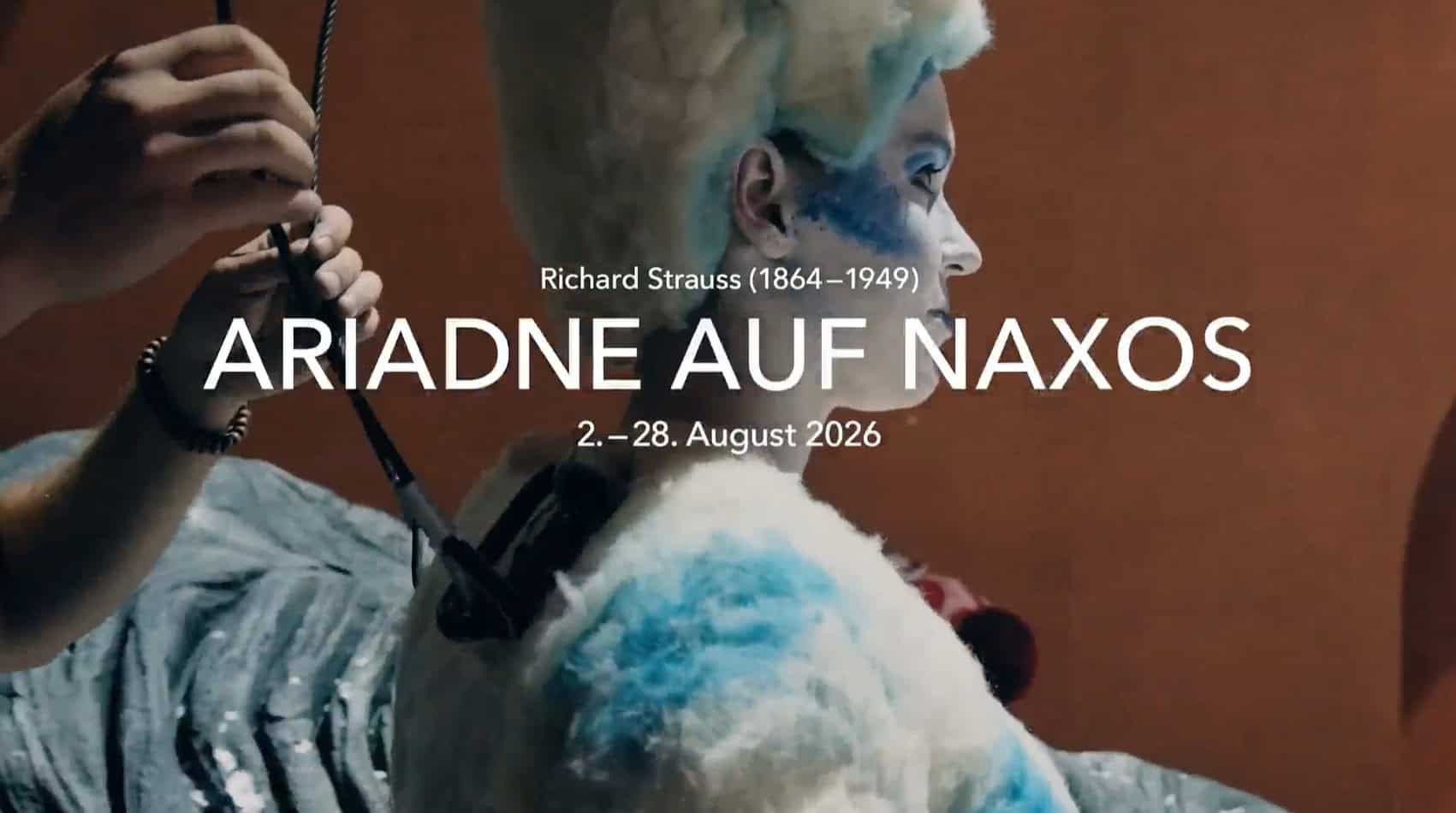
From problem child to showpiece: Ariadne auf Naxos is a jewel from the workshop of Hofmannsthal/Strauss.
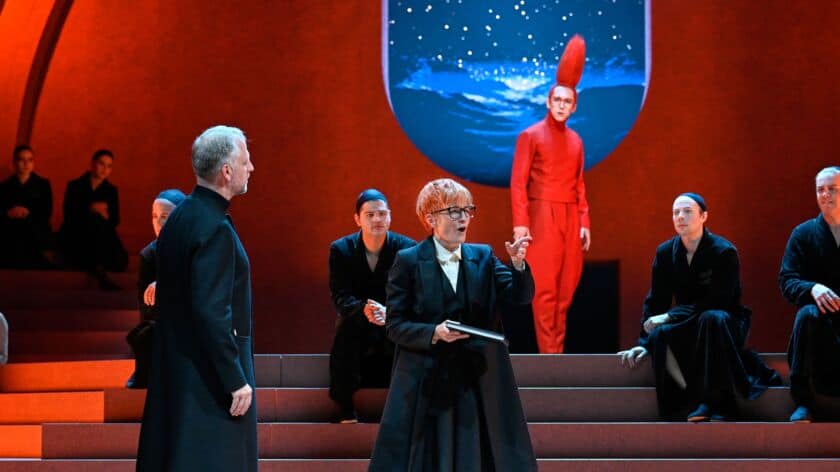
Artless is not the word for it. Hugo von Hofmannsthal’s and Richard Strauss’s Ariadne auf Naxos is one of the most intricate artworks of the early 20th century, tossing baroque theatrical figures and ancient mythology together in colourful disarray. At first glance, no one could say how this piece actually works. Only the quirky Zerbinetta is granted a few lines by Hofmannsthal, in which she – “The piece goes like this …” – explains briefly and lucidly to her fellow performers what they need to know about it. To this day it gives the opera audience a mischievous pleasure to listen in.
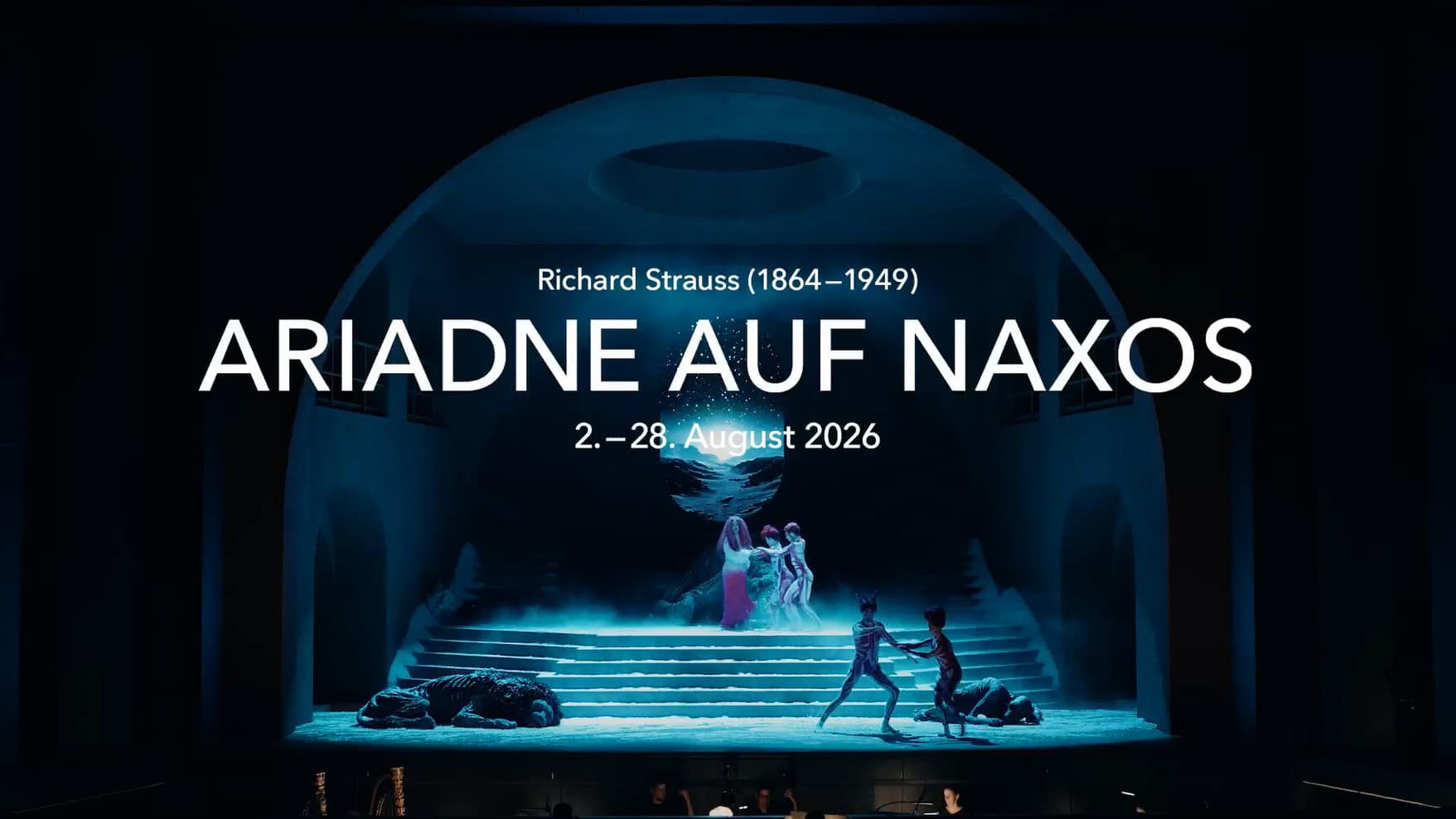
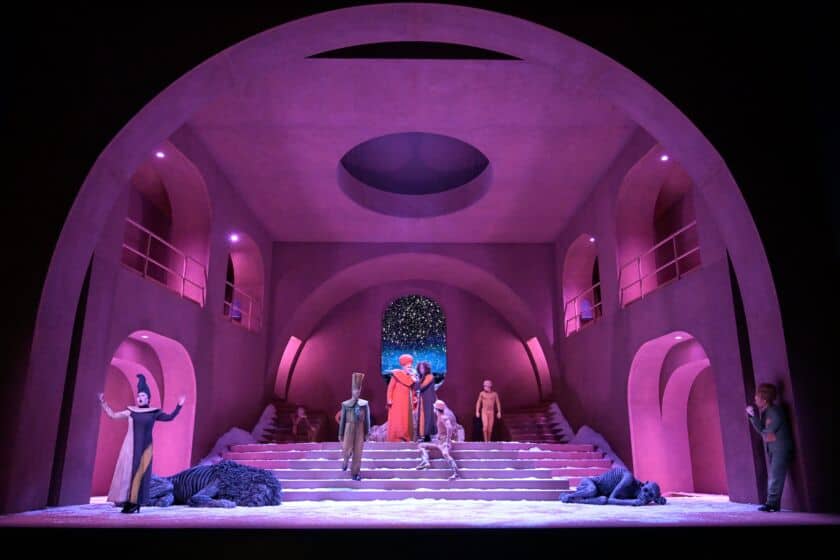
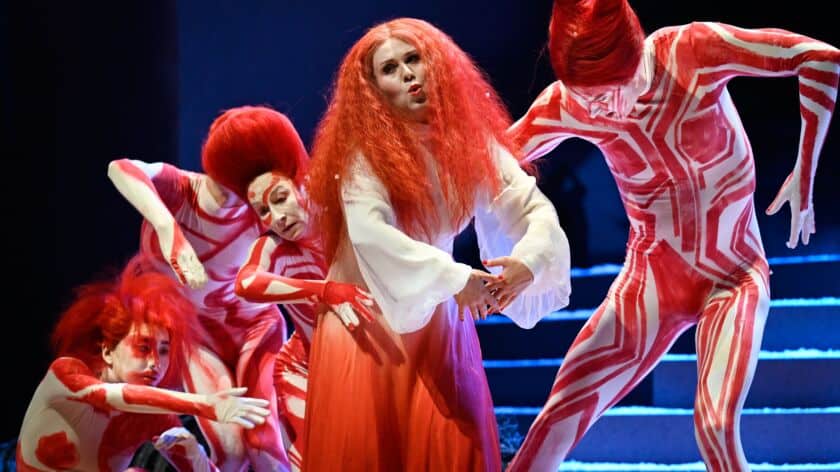
Mars Theatre. Ariadne has indisputably become one of the most frequently performed operas of this era and exerts an inexplicable (or, if we take Zerbinetta at her word, entirely inevitable) fascination, which a contemporary director naturally wishes to redefine. Salzburg debutant Ersan Mondtag intensifies the artificiality further and sets the piece on Mars. Originally, everything had been planned quite differently. Ariadne auf Naxos was meant to be the “afterpiece” to Hofmannsthal’s new adaptation of Molière’s Der Bürger als Edelmann (Le Bourgeois Gentilhomme). This parvenu exercises himself in all the artistic accomplishments of the nobility and also maintains a theatre in his house. And in his megalomania he orders the ancient piece to be combined with the harlequinade, so that he will not be bored among Greek gods and heroes.
Instead of the closing ballets customary in Molière’s day, in 1912 an opera was created as a “merry-sorrowful” puzzle-play about the riddles of love. Here the life-loving Zerbinetta with her suitors, there the Ariadne abandoned by Theseus, who is ultimately redeemed from her solitude. At the climax of the interweaving of the two plot strands – which on the surface have nothing, and in depth a great deal, to do with each other – the comedian gives the princess a lecture on fidelity and above all infidelity. And insists on the all-too-human. Strauss always relished such layers of ambiguity. On the path via musical modernism (Elektra, 1909) the composer had long since moved with Hofmannsthal’s Der Rosenkavalier (1911) into new territory. The composer promised his poet that he would lay aside “the Wagnerian musical armour”. Mozart was to be the new idol.
Limited Forces, Full Power. As if in signal of this, Strauss reduces his customarily huge orchestra for Ariadne auf Naxos to 36 players. This was not entirely voluntary. He was compelled to do so because the new work was to premiere in Stuttgart and because the first acts of Der Bürger als Edelmann required only incidental music with as many Lully quotations as possible. This compulsion towards lightness was on the other hand inspiring. Strauss found for the scenes of the commedia dell’arte players around Zerbinetta and Harlequin a genuinely neoclassical tone, without having to abandon his unmistakable harmonic language. When Bacchus finally appears, the sounds of the three dozen musicians swell as if three times as many were seated in the pit. Strauss had long since mastered orchestration …
The “little opera” (Strauss) was exquisite. But it was a failure. The premiere of this fusion of spoken and musical theatre was unsuccessful for practical reasons, even though Max Reinhardt, the favourite director of both creators, had been involved in the project from the beginning. Which means we can actually call the piece the Salzburg opera par excellence, since Reinhardt, Strauss and Hofmannsthal were the Festival’s founders: eight years after Der Bürger had come to grief in Stuttgart, the first cries of Jedermann rang out on the Cathedral Square – and in 1926 Ariadne was the first Strauss opera to be performed at the Festival.
But by then it was no longer the afterpiece to a Molière comedy, but embedded in a completely new dramaturgy. For the Vienna premiere in 1916, Hofmannsthal had written, incorporating elements from Der Edelmann, his own “prologue” which now made a wealthy Viennese burgher the originator of the theatrical melange. Incorporated in this is the person of the young Composer, a trouser role like that in Der Rosenkavalier, who is in despair at his patron’s lack of culture. That he finally agrees to the adulteration of his drama by the inclusion of comic scenes has not only to do with the fact that “the rich gentleman” has not only ordered the thing, but also paid for it, but also – and this is important for an author always attuned to erotic nuances – with the fact that he has fallen a little for the cheeky Zerbinetta.
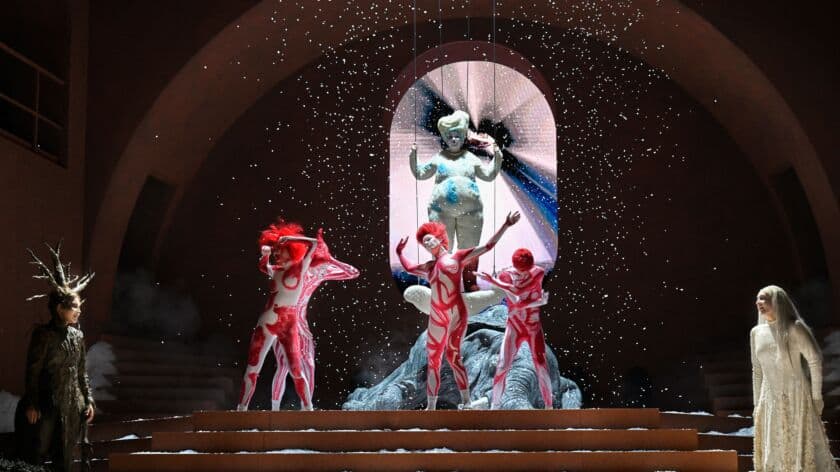
Rich in Allusion. The many subtleties and delicate threads of relationship in Hofmannsthal’s writing continue to this day to ensure the success of the revised version, whose prologue the composer so incidentally found the long-sought new parlando tone. The directors of the 21st century have, of course, their share of trouble with the many historical and classical references in text and music. For them, Ariadne is a hard nut to crack. Ersan Mondtag has also pondered how he might bring its strange events into our present. He has come to the conclusion that he would rather make from the 1912/16 parable a dystopian narrative from the future – a future that might perhaps be closer to us than we would like. He relocates the scenery to Mars. More specifically: to a bunker deep beneath the Martian surface, into which memories of gazing into space, at Earth and other planets, can drift in – even a little snow, through imitation church windows.
Flight and Rapture. Molière’s bourgeois and the richest man in Vienna from Hofmannsthal’s new version – they are, says Mondtag, typical representatives of a decadent society which in this case has fled from Earth – devastated, perhaps, by wars or plagues – to Mars, and now not only wants to survive but also to bring a residue of culture into its bunker.
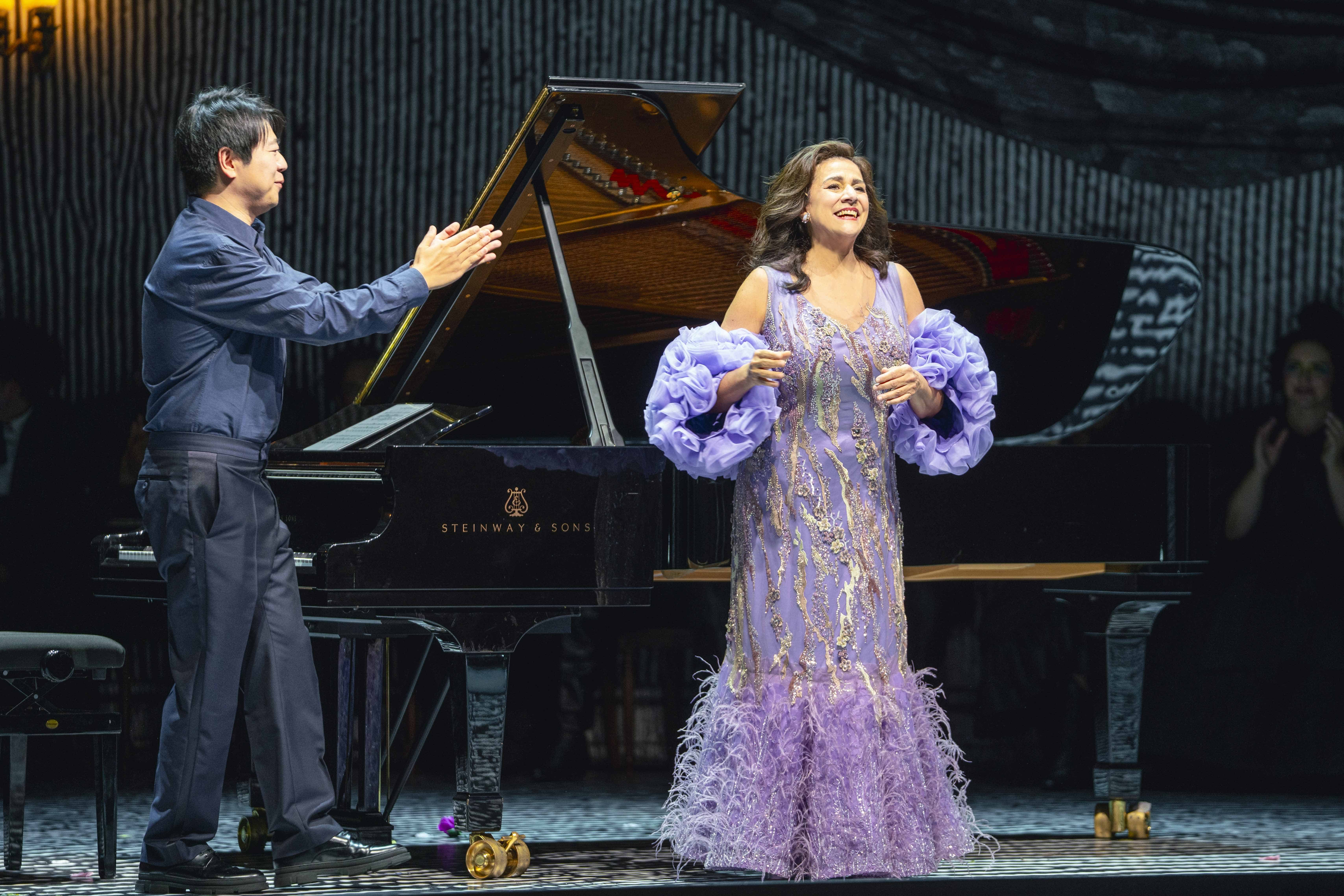
And so one might perhaps trace an Ariadne thread through Hofmannsthal’s intellectual labyrinth. How have artists and audiences arrived at his Mars theatre? “Probably in private spacecraft,” says Mondtag. One of the passengers: Elina Garanča (Elina Garanča hat to cancel her appearance, Christina Nilsson is taking over the role) appearing for the first time in the title role – we are, after all, at the Salzburg Festival! That the Vienna Philharmonic plays in the pit has always been one of the Festival’s luxuries, which not only Martians will appreciate. In chamber-music proportions, the orchestra can develop its Strauss expertise with particular sensitivity – this time under Manfred Honeck, who experienced this opera as a member of the orchestra under Karl Böhm’s direction.
The Festival history of Ariadne is particularly rich. The first Festival production exactly 100 years ago was studied by Clemens Krauss, and the composer himself conducted one of the performances! The Philharmonic are also honouring the Festival co-founder in 2026 with two early tone poems (Don Juan and Till Eulenspiegel under Andris Nelsons, 29/30 August) and the late Metamorphosen (Chamber Concert, 3 August).