Hymns to the Voice
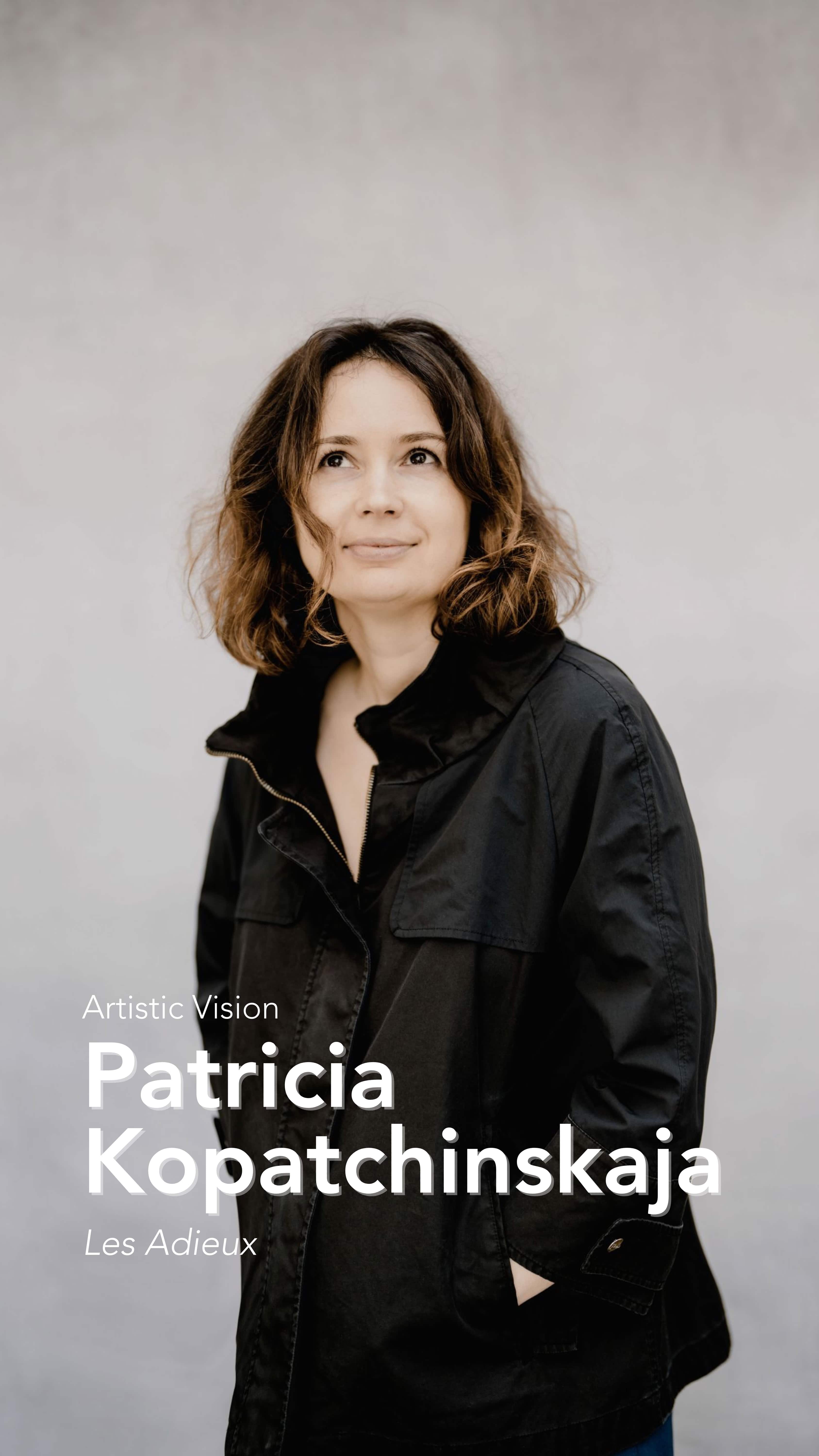
The Festival dedicates a portrait to the Italian composer Francesca Verunelli and her subtle music, infused with emotion and a spirit of inquiry.
It is as though human voices were flowing into one another as they slowly drift through the infinite expanse of the universe – a paradox, for in a vacuum sound cannot propagate. Past and future seem to merge into one in these songs of beautiful mystery, painful clarity and unadorned magnificence. The voices "de-tune" themselves in the tiniest steps – and yet they are on the right path of their cosmic hovering. "There is no more original sound than the human voice. It transforms the human body into a vibrating body": so the Italian composer Francesca Verunelli, born in 1979 in the Tuscan town of Pietrasanta, formulates it. In her 2024 work „VicentinoOo“, Verunelli conducts sensitive dialogues with early music – beyond our conventional tempered tuning system.
Finest Gradations. Tempered tuning? Even from everyday human life it is familiar: what sounds wrong can depend on the particular mood of those involved. In music, tuning has always given cause for puzzlement. For seven stacked pure octaves (with the vibration ratio 2:1) and twelve pure fifths (with the vibration ratio 3:2) are simply not exactly equal in size; the difference
amounts to barely an eighth of a tone. Every method of dealing with this natural “error”, however, has its drawback. The tinkerer Nicola Vicentino, gifted with the finest ear and a spirit of inquiry, was inspired by this in 1555 to build the “Archicembalo”: this instrument could play no fewer than 31 tones per octave – and thereby enabled pure, mathematically perfect harmonics.
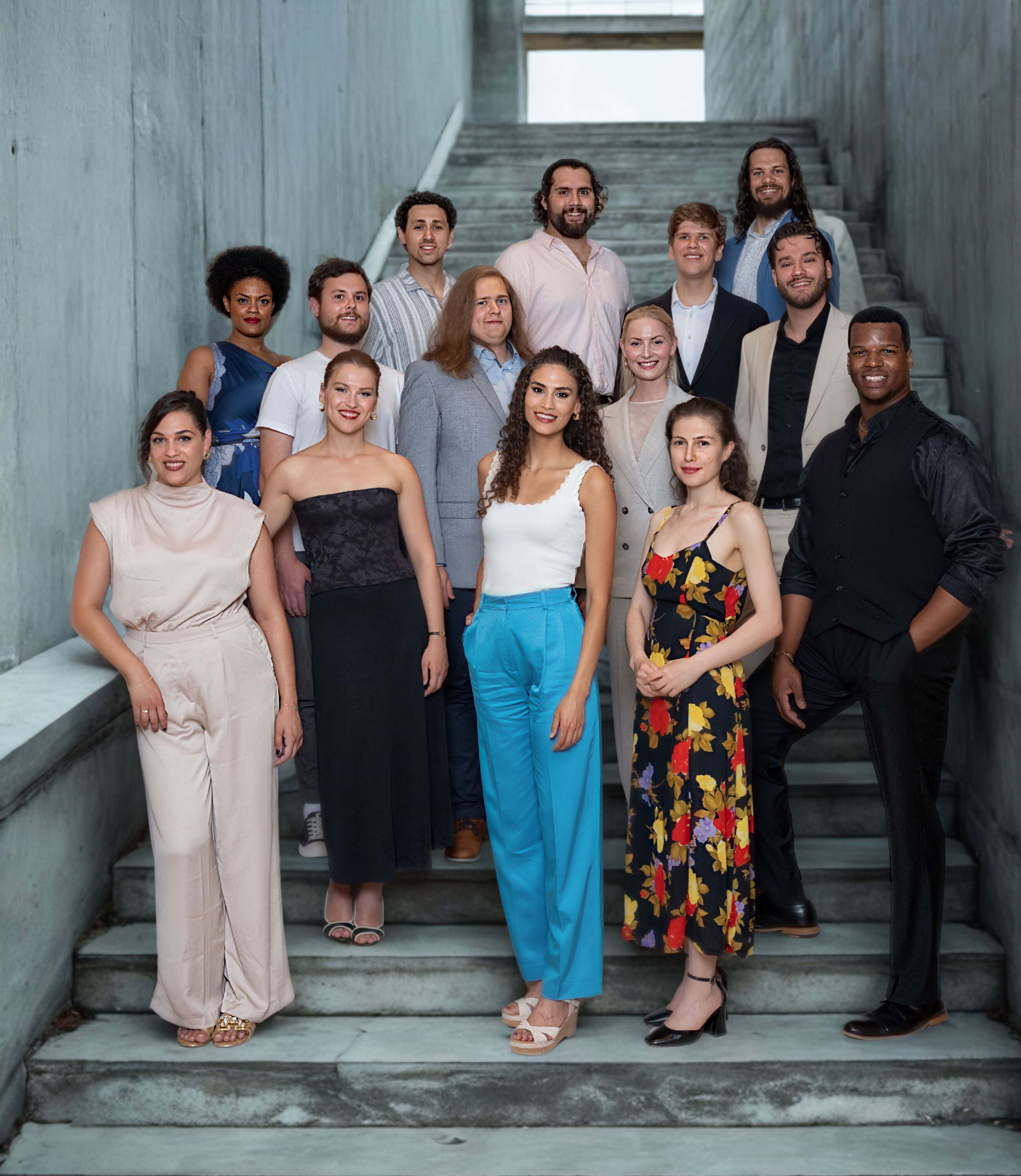
“I always felt the need to work beyond the boundaries of equal temperament,” Francesca Verunelli confides. From discussions with Geoffroy Jourdain, the director of the vocal ensemble Les Cris de Paris, Verunelli’s composition „VicentinoOo“ for voices and two triple harps finally emerged: 21st-century music embedded in a sequence of experimental madrigals from the Renaissance, by Sigismondo d’India, Cipriano de Rore, Luzzasco Luzzaschi, Carlo Gesualdo – and of course Vicentino himself. This work cycle, already internationally acclaimed under the title „Strana armonia d’amore“ and released on CD, forms at the Salzburg Festival on 11 August the first of two evenings in the Great Hall of the Mozarteum that will portray Francesca Verunelli and her compositions while also situating them in a broader musical context.
Who Sings, What Sounds? “It seems to me that the composers of the Renaissance had a sensitivity for harmonic colours and a finesse in precise execution,” says Verunelli, “that are very similar to the harmonic experiments of contemporary music. The manifold properties of Vicentino’s subdivision intrigued me and I began to research its potential thoroughly.” And with unheard-of demands on the ensemble’s intonation precision.
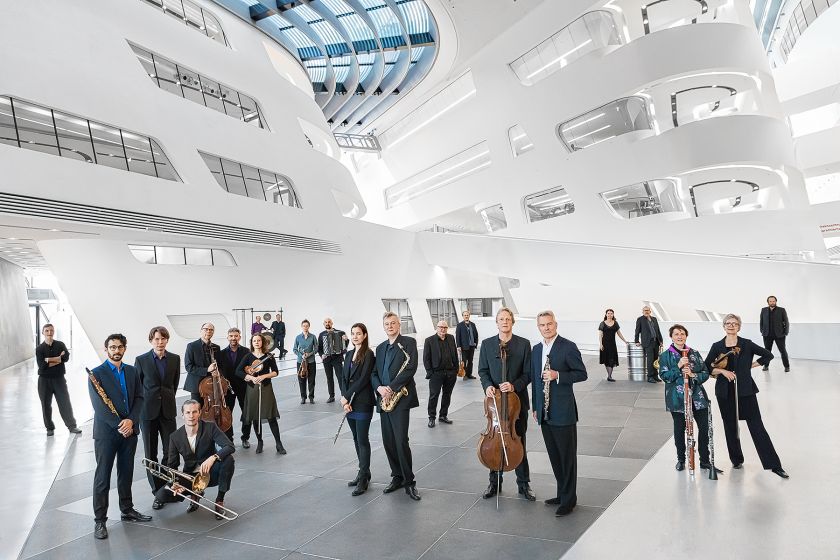
The following evening, Johanna Vargas (soprano), Helēna Sorokina (mezzo-soprano) and the Klangforum Wien under Emilio Pomàrico show how Francesca Verunelli explores another magical moment of hearing and singing: the composer is concerned with the fraction of a second between hearing a sound and recognising that it is a human voice. In her piece „La nuda voce“, created in 2025 on commission for the Donaueschingen Music Festival, “I dreamed,” says Verunelli, “of holding that brief moment for as long as possible.”
Rooted in Home. The musical primal experience of the voice and the binding power of song also indebts this work to numerous childhood memories. The text she uses is a folk song from the region where she was born and grew up. Paradoxically it deals with the loss of voice: “Dov’è la voce mia, ch’era sì bella? – Where has my voice gone, that was so beautiful?”
“There are so many people,” the composer explains, “who today have no voice, who are not heard. We are lucky enough to have the right to speak our mind, but does anyone listen? When people in a community sing together, no voice is useless, regardless of whether it sounds particularly beautiful or less beautiful, pure or not. For me, music is a form of being human.”