The Programme of the Salzburg Festival 2026
The Birth of Time and the Power of the Heart
Boundaries begin to blur, ways of living and belonging are challenged and existential horizons widen. The figures on stage at the 2026 Salzburg Festival tirelessly navigate the space between themselves and others as they press toward selfdiscovery. Along the way, they unfurl a panorama of love in all its guises. Delving into the self, they pit the heart’s power against reason, and intuition and feeling against cold rationality. ‘Le coeur a ses raisons que la raison ne connaît point.’ — ‘The heart has its reasons, which reason does not know.’ (Blaise Pascal)
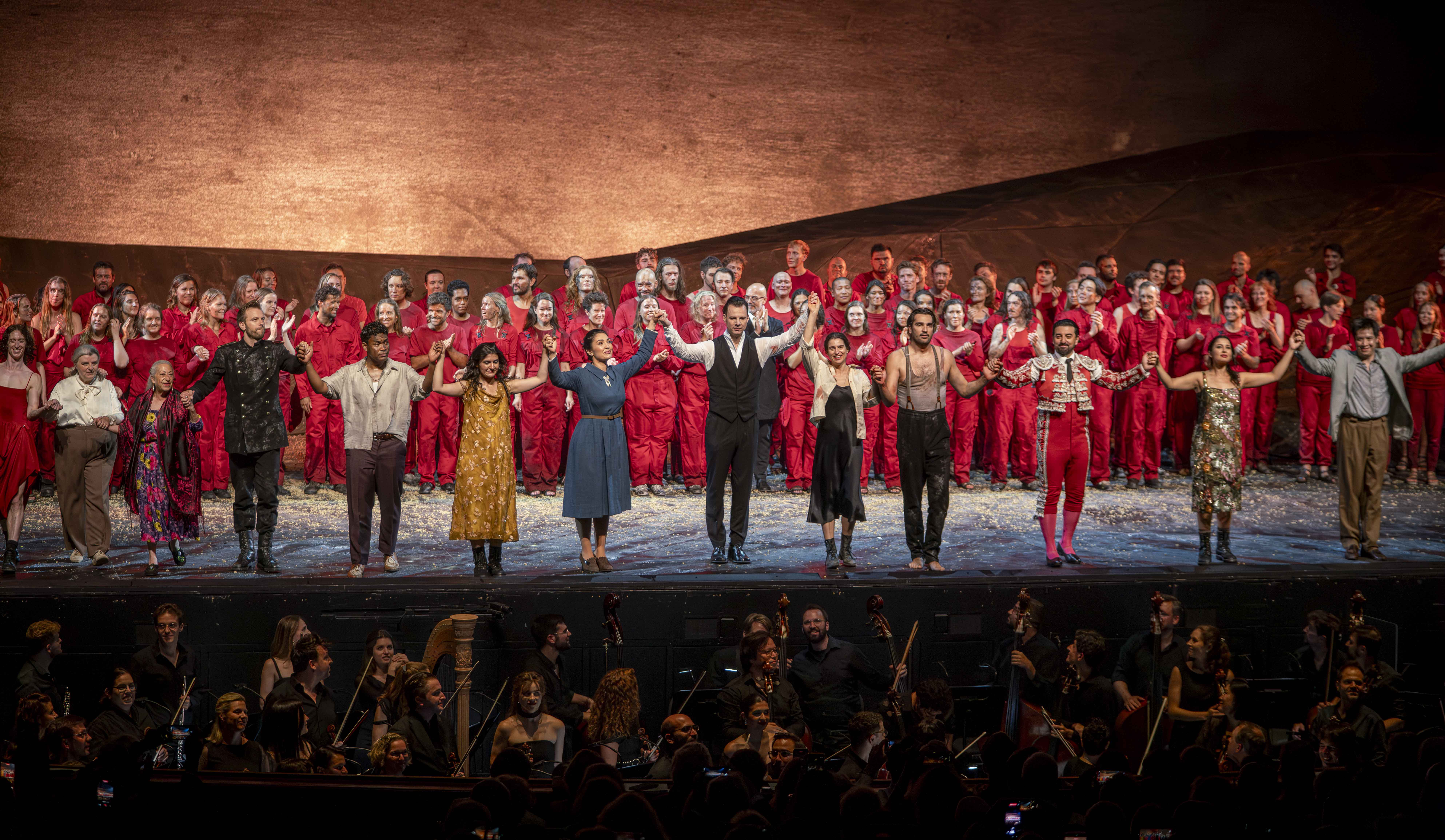
In Carmen, a fiercely independent woman pursues freedom in life and love, breaking with convention as radically as Saint Francis and Molière’s Alceste. — From the depths of his despair, a broken man cries out in De Profundis, Oscar Wilde’s haunting prison letter. — Mozart’s ‘scuola degli amanti’, Così fan tutte, lets loose an unusual social experiment that shatters every certainty, upends the lives of its participants and exposes startling new insights and feelings.
In Ariadne auf Naxos, Hofmannsthal and Strauss present a world of contrasts in which tragedy and comedy overlap, and the divergent orbits of grief and levity are drawn into one another. In an equally witty and tragicomic register, Molière’s The Misanthrope delivers a takedown of theatrical life and cultural emptiness with its biting satire on social hypocrisy and superficiality. Elfriede Jelinek’s latest drama, Unter Tieren (Among Animals), similarly probes the depths of a deceitful society, using powerful language to chart a path ‘into the apocalypse of capitalism’.
As a counterpoint to capitalist excess, the life of Saint Francis of Assisi presents a radically different model of living — one of poverty, devotion and an elevated existence outside the normal flow of time. It is this life that forms the basis of Olivier Messiaen’s opera Saint François d’Assise, a work that defies conventional dimensions. Here, the ordinary laws of space and time seem suspended, as spiritual transcendence and the surrender of worldly attachments are taken to their fullest expression.
Likewise unbound by time and place is the wanderer in Peter Handke’s Schnee von gestern, Schnee von morgen (Snows of Yesteryear, Snows of Tomorrow). We follow him as he quietly reflects on the passage of time, roaming over delicate landscapes of experience and memory. Opposite him stands a restless seeker: Faust, the archetype of a modern human being, driven by his pursuit of knowledge, experience and self-fulfilment. Both take stock of the world, yet in profoundly different ways; each moves through — and at times becomes lost within — the inner and outer dimensions of mind and soul.
Wajdi Mouawad’s play Europa’s Pledge reflects on our fall from innocence and the necessity of taking personal responsibility. In a similar way, Ingeborg Bachmann and Hans Werner Henze confronted private and collective traumas in their works. Guilt — and the journey towards reconciliation — also connects directly to the Ouverture spirituelle, which this year takes its thematic inspiration from the opening word of one of the Penitential Psalms: ‘Miserere’.
The figures we encounter in the 2026 Festival programme journey inward, seeking to interpret the ‘chambers of the mind and heart’, as Virginia Woolf described them, and in doing so reveal new horizons of possibility. They strive to comprehend the suffering imposed upon us by reality — a suffering embodied in the character of Jedermann (Everyman) and rooted in the burden of temporality.
Our fundamental awareness of time and the finite nature of existence is what connects us with our fellow human beings and the world around us, giving rise to our search for meaning — a search that finds expression in the dramatic arts, and especially in music. Art and music draw close to time itself, making its passing something we can see and feel. ‘Suppose that there were a single beat in all the universe. One beat; with eternity before it and after it. A before and an after. That is the birth of time.’ (Olivier Messiaen)
TICKET ALLOCATION PROCEDURE
All orders arriving at the latest by the Deadline (20 January 2026) will be handled equally, irrespective of when they arrive. This means that orders are not processed in the order in which they arrive. Notification of the extent to which the order is as requested processed will be sent by end of March 2026 at the latest.
Orders received after the deadline will only be processed after all orders placed before the deadline have been filled.