The Drama Programme 2026
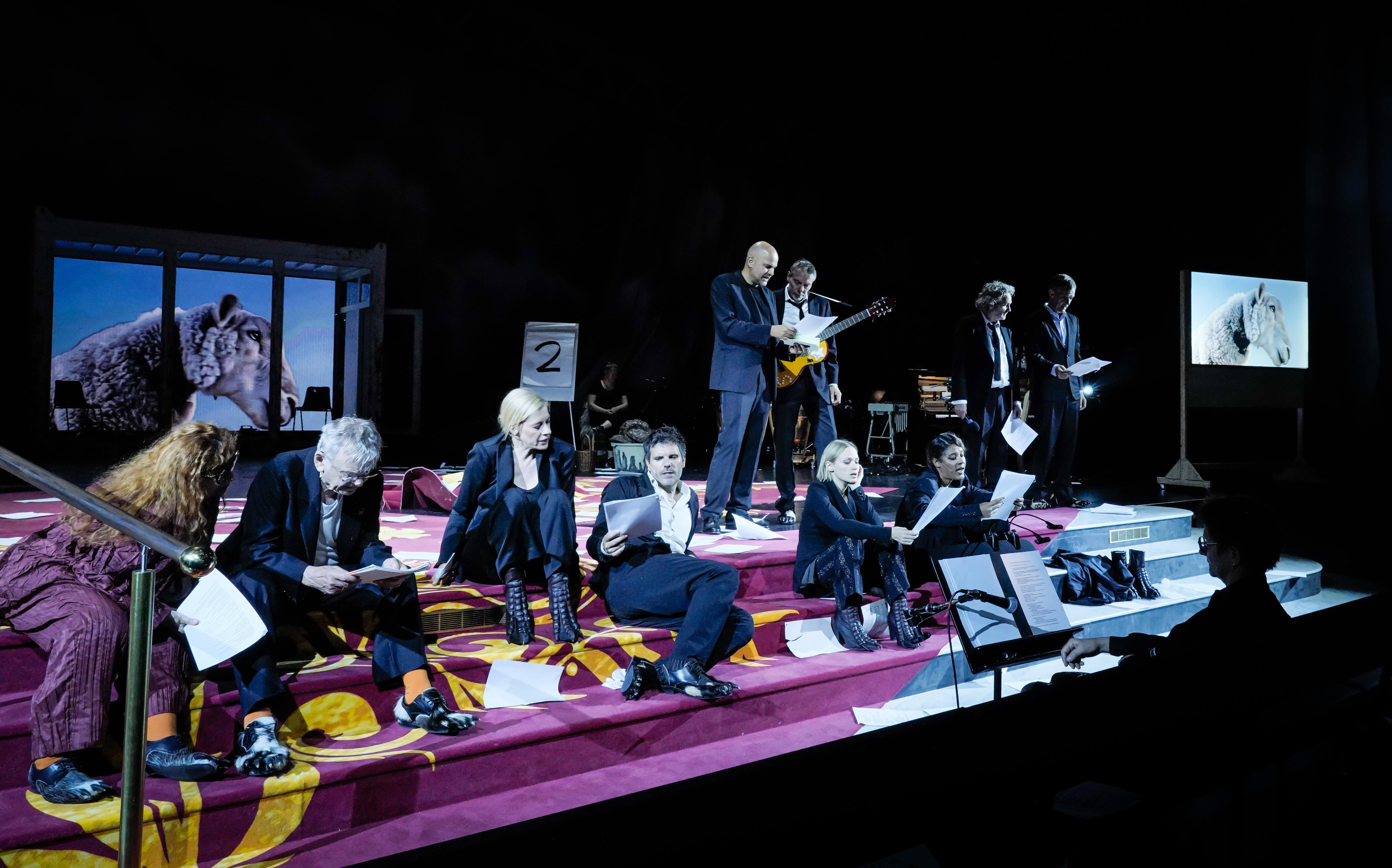
Molière, whose scathing comedies offer a “preview” of the ideas of the Enlightenment, represents a double connection between the opera and drama programme of this summer: from love’s double life in Ariadne to love’s ground zero in The Misanthrope. Furthermore, the reckoning with the lack of culture portrayed in Ariadne auf Naxos by Strauss and Hofmannsthal (whose original draft envisioned Molière’s Bourgeois gentilhomme as the prologue to the opera) has an eloquent counterpart in The Misanthrope: the piece is a caustic satire of the hypocrisy and superficiality of society, exposing a social masquerade. Elfriede Jelinek’s latest play, Unter Tieren, also aims for the shallows of a mendacious society, painting an eloquent portray of the road “to the apocalypse of capitalism” – for which the life of Saint Francis of Assisi, in turn, offers a radical countermodel.
A tender movement between yesterday and tomorrow, past and future is spelled out by Peter Handke’s “Man pacing” in Schnee von gestern, Schnee von morgen. We accompany his quiet meditation on the endangered human heart – “THE HEART OF ALL THINGS in you and me” –, on time and memory. The opposite pole is the restless searcher we encounter in the character of Faust: the archetype of modern man, striving for knowledge, experience and fulfilment, to whom love is egotism.
From Molière to Goethe to the latest works of the Nobel Prize laureates Elfriede Jelinek and Peter Handke, the drama programme reflects fundamental discourses in the European history of ideas: from Enlightenment to modernism, and all the way to our present day.
The drama programme is complemented by readings and solo pieces. Peter Handke’s A Sorrow Beyond Dreams (Wunschloses Unglück) will be performed by Bibiana Beglau. Elfriede Jelinek, the uncompromising critic of social power dynamics, has not only the world premiere, but also a reading dedicated to her: Winterreise with Birgit Minichmayr. Here, the author circles “the black hole of time, which knows only passing”, the phenomenon of being out of synch with one’s own time, combining Schubert’s theme of being a stranger to the world with her own biography and the “madness of our immediate present”.
One special focus is on Ingeborg Bachmann, one of the most important literary voices of the 20th century, who would have been 100 in 2026, the year that also marks the 50th anniversary of her death. In a staged reading entitled Ingeborg Bachmann. Wer?, Jutta Ferbers interweaves poems and excerpts from the novel Malina and other prose texts by Bachmann in an inner biography, to which Anna Drexler, Mavie Hörbiger, Sophie von Kessel, Sylvie Rohrer, Valery Tscheplanowa and Christoph Luser lend their voices.
First published in the Festival insert of Salzburger Nachrichten