
Faust I
Johann Wolfgang von Goethe
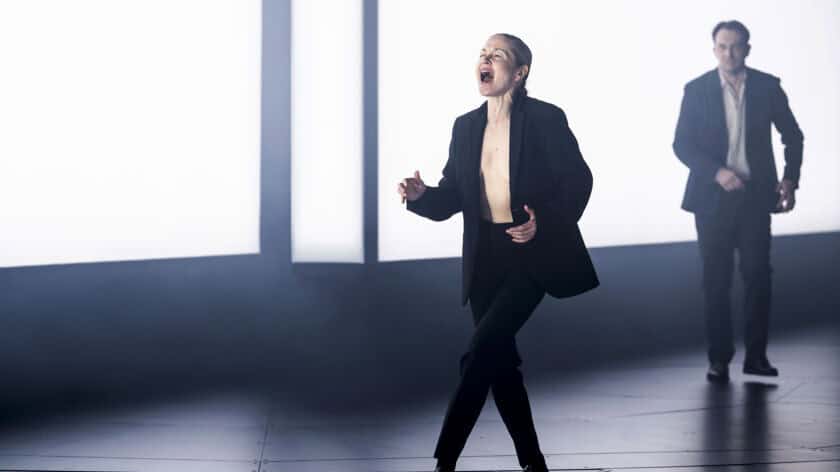
In the character of Goethe’s Faust, we encounter the archetype of modern man, striving for knowledge, experience and fulfilment, whom Ulrich Rasche’s new production at the Perner-Insel plans to portray as a manifestation of opposing forces.
Since the 16th century, the story of Doctor Faust – the scholar who sells his soul to the Devil – has stood at the heart of the European literary tradition. In early versions, it served as a warning of human hybris: anyone who believes himself above divine order ends in perdition. At the end of the 18th century, Goethe radically transformed the material, catapulting it into the midst of modernism. Goethe, who – in the words of the Spanish philosopher Ortega y Gasset – spent his life “searching for or avoiding himself”, turns the famous sinner from the folk tale Historia von D. Johann Fausten into a restless, desperate seeker – torn between extreme self-confidence and the loss of self that threatens him.
“Two souls, alas, are housed within my breast” – in that famous sentence, Faust voices his basic conflict: he is inwardly torn between insight and desire, sense and sensuality. What drives him, however, is not a wish for equilibrium, but transgression. Faust takes the propulsion of transgression so far that it turns against himself. What begins as a search for experience ends as alienation from his own life.
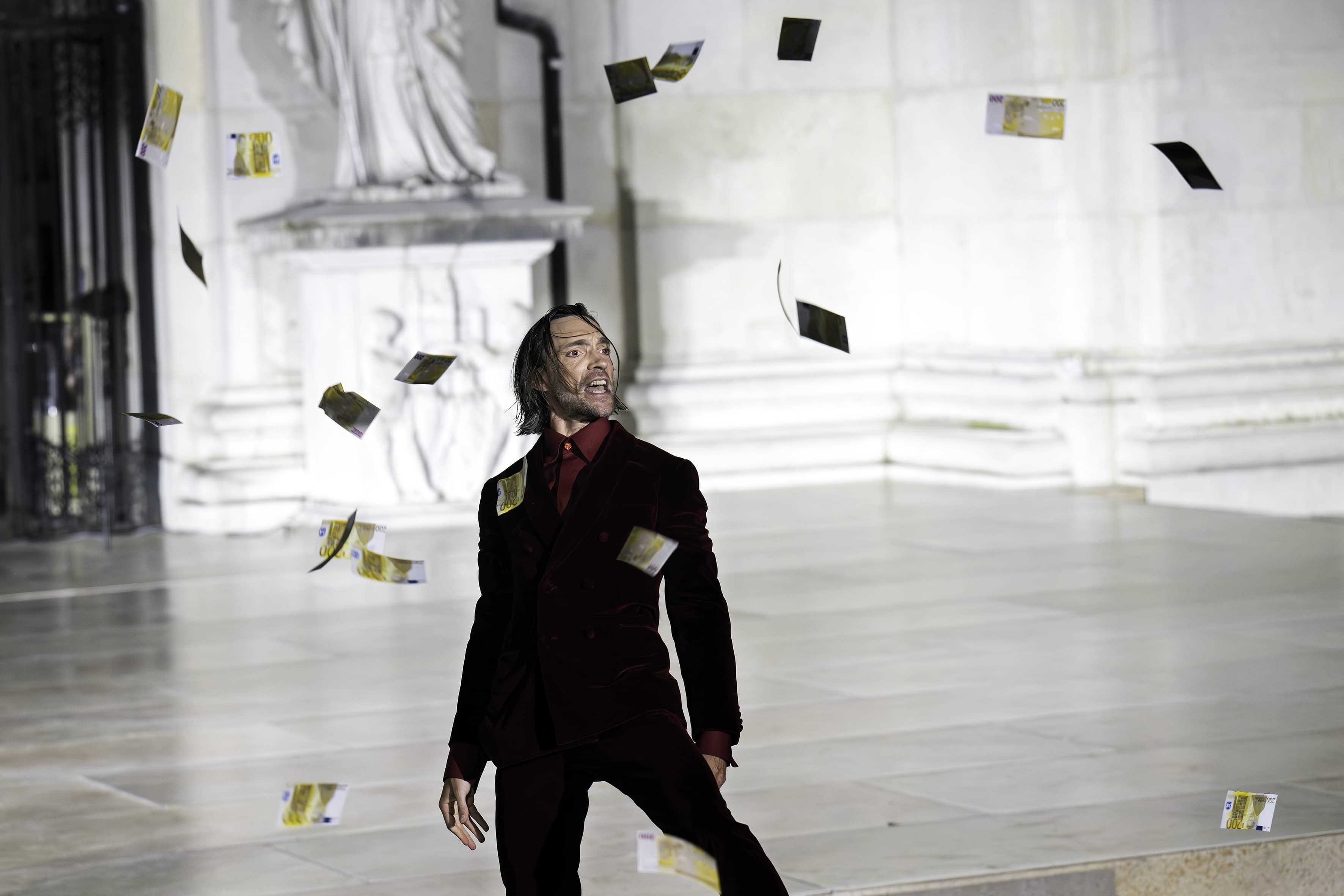
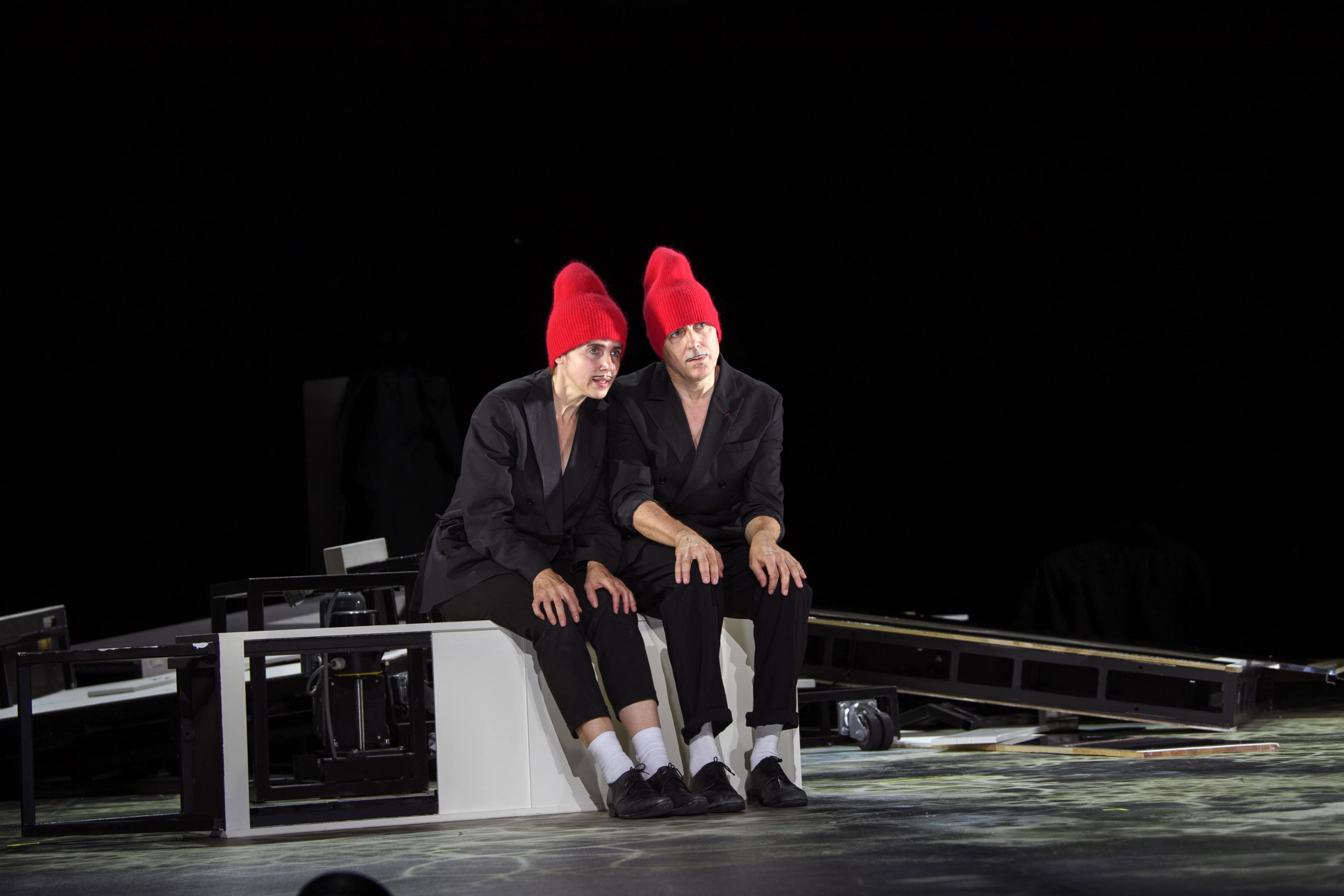
Ulrich Rasche boils the action down to a contemporary chamber play. The world retreats to an inner space in which the figures appear as manifestations of opposing forces. Mephisto (Valery Tscheplanowa) appears less as an outside force than as the shadow of Faust (Steven Scharf and Johannes Nussbaum) himself – an expression of his own destructive energy. “Mephisto is the opposite, the shadow side of Faust, the side that always pursues him, is always present,” Ulrich Rasche explains. “It is seduction, the structure of his desires, excess, experience of the world, embrace – in contrast to what Faust has been doing so far, namely the search for insight, the withdrawal into science, into his study.”
Herein, Faust acts like a character of our present time: successful, confident, capable. He has achieved everything, he functions perfectly, but nothing is ever enough for him. His crises remain invisible. Knowledge, power, love – everything becomes an attempt to overcome the distance separating him from life, by seeking out ever more intense experiences: excess as one last effort to reconquer the lost feeling of presence, by violent means.
In contrast, Margarete (Anna Drexler), the famous “Gretchen”, appears not only as a tender lover and tragic victim, but an emancipated counterpart for Faust, an opposing principle which Faust can never possess. She embodies a totally different way of being in the world, evading his destructive dynamic and finally setting a clear boundary: “Heinrich! I shudder to think of thee.”
From Gretchen’s story, the narration follows its trajectory, opening the horizon to a possible future, pointing beyond destruction. – “She is saved!” is the last sentence in Faust I.
Yvonne Gebauer
First published in the Festival insert of Salzburger Nachrichten