
Intimacy on a Grand Scale
As soloists or in chamber music, sung or instrumental: the best of the best once again pass through Salzburg.
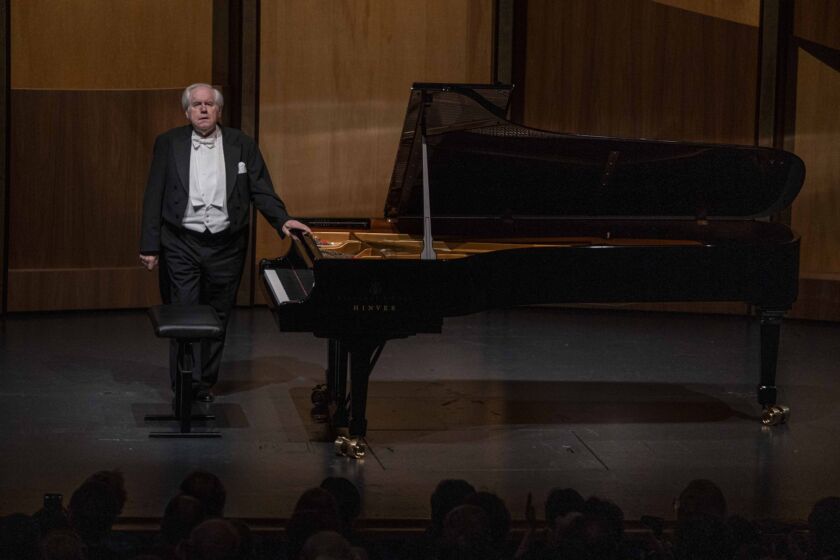
The procession of pianists this year is opened (on 28 July) by Grigory Sokolov, for many years a guarantee of a sold-out Großes Festspielhaus. He always arrives with a three-part programme, of which initially often little or nothing is known. This time the secret of both “official” parts of the evening is fixed: he begins with Beethoven’s E-flat major Sonata op. 7 and the Bagatelles op. 126 – thus with a programme of contrasts without equal, for in the early sonata the composer is emphatically lyrical over long stretches and spins wide, singing arcs; in the later, tersely noted, brief pieces he tells bizarre, mysterious stories that seem to disregard every “classical” formal framework. After the interval Sokolov plays this time Franz Schubert’s last great piano sonata (B-flat major, D 960), a work that, a year after Beethoven’s death, extends the sonata form into new dimensions. Then come, as the admirers of this artist can by now rely on, very many encores that taken together form a further programmatic unit, the third surprise, which at Sokolov is absolutely de rigueur.
Viennese Things Old and New. Essential for the chronologically next pianist in the Festival programme, Pierre-Laurent Aimard, are associative connections between Classical and/or Romantic music and works of modernism or contemporary composers. So on 31 July at the Mozarteum, excerpts from the “Games” (Hungarian: »Játékok«) by György Kurtág appear alongside Ländlers and waltzes by Franz Schubert – small forms, as if improvisatorily invented. In Schubert’s case these are probably really notated recollections of spontaneous inspirations that the composer offered up at sociable evenings at the piano.
A Mozart Andante then, commissioned by Count Deym for the barrel organ – a mechanical musical instrument in a then sensational art cabinet near the Viennese Rotenturmtor. A caprice that did not prevent the master from making something serious from the play: the little piece may appear outwardly inconspicuously compact, but inwardly it is rich in charming musical content – a work dating from May 1791, one of the last months of Mozart’s life. Aimard confronts this gem with the terse but no less ambitious piano pieces op. 19 by Arnold Schoenberg. So-called atonality reaches its most extreme concentration in these compositions at the beginning of the 20th century – and simultaneously its crisis, which ultimately led to the development of the so-called twelve-tone method. This was meant to make it possible once again to develop larger forms in “free” harmonic space. Schoenberg’s pupil Anton von Webern adopted his teacher’s compositional technique and with his »Variations« op. 27 wrote one of the outstanding examples of the aesthetic of the “Vienna School”. Classical formal worlds were to be redefined. Webern’s Variations are simultaneously a three-movement “sonata” structure and actually, for all the variety of their sound shapes, developed from a single twelve-tone row.
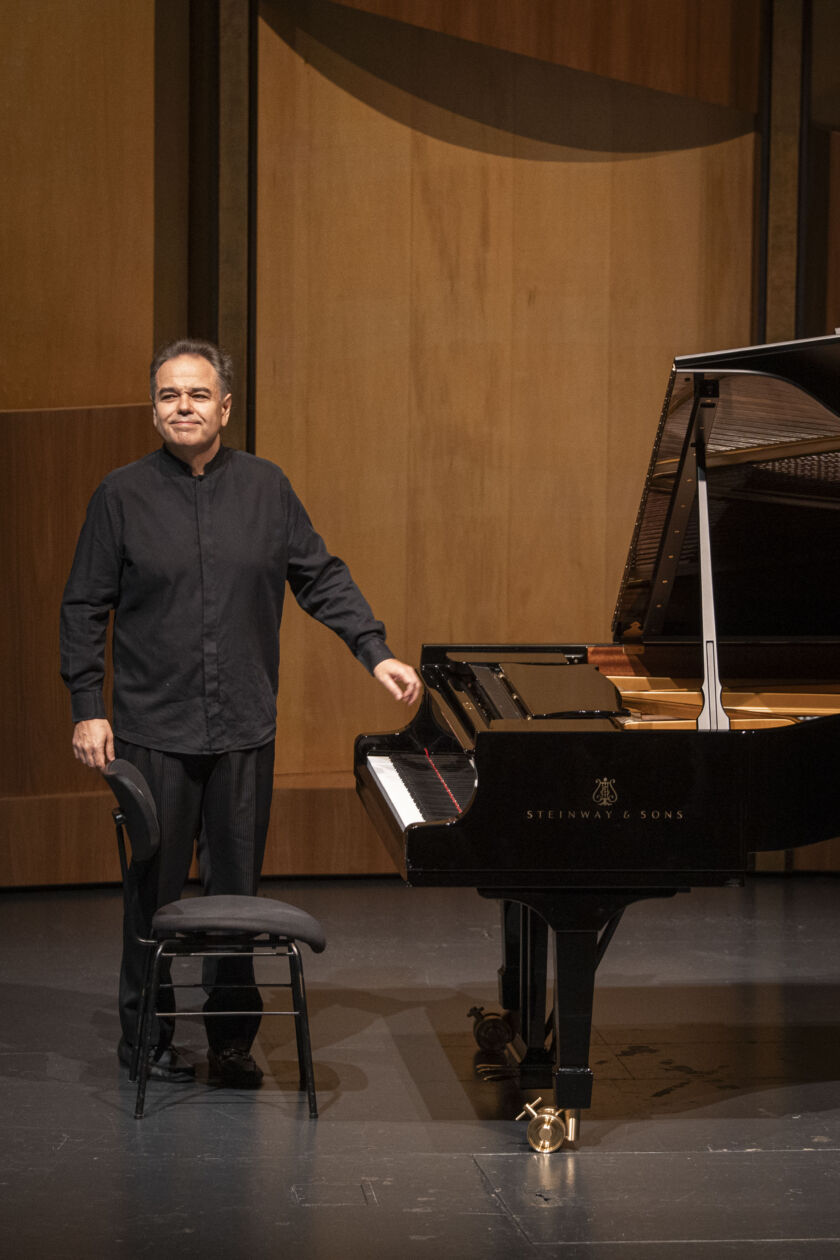
Like a Funeral Cortège. As if the piano evenings of this year’s Festival were meant to grow into a self-contained chain of ideas, Arcadi Volodos too on 9 August places Chopin Mazurkas at the opening of his recital at the Großes Festspielhaus. He follows the content-laden small forms of Chopin’s architecturally ambitious large-scale project, the Second Piano Sonata (B-flat minor). It is familiar beyond the concert hall for its slow movement, a funeral march that has taken on an independent life as ceremonial accompaniment and thereby forfeited its place as catalyst of a sensitive psychological narrative within the sonata. In the sonata it stands after fierce storms of the soul – and before the ghostly finale, which belongs to the singular moments of musical history: such a haunting sound structure had never existed before and has since been emulated at best as a Chopin parody. That after the “burial” the storm sweeps over the graves is an all-too-obvious association; Volodos encounters it after the interval with Schubert’s G-major Piano Sonata, one of this composer’s earliest attempts to give the classical form new dimensions and those (later so-called, by Robert Schumann) “heavenly lengths” that seem to suspend all laws of time and space.
From North and East. The following day Alexander Malofeev connects directly in the Mozarteum with Schubert’s “Three Piano Pieces” D 946, among Schubert’s very last works, sketchy, freely formed, as if they were drafts for a third series of the popular »Impromptus«. Where would Schubert have gone from such visionary experiments? He certainly opened up mental worlds that afforded the Romantics rich adventures in the wake. Against the bold Schubert pieces Malofeev sets from the Suite »Aus Holbergs Zeit« (From Holberg’s Time) the severe, nostalgic formal exercises of the Norwegian Edvard Grieg, but also some of the little-known piano pieces of the great Finnish symphonist Jean Sibelius and three Russian masters, of whom at least one, Alexander Scriabin, did not hold Schubert in high regard: “For little girls at the conservatory,” he once disdainfully remarked, but wrote a fragrant, atmospheric and euphorically heightened piano waltz (op. 38) that could even reconcile a Viennese Schubert enthusiast. Alongside these, five “fragile Préludes” by the barely known Arthur Vincent Lourié (1892–1966), whose work contains several attempts to resume Scriabin’s ambitious esoteric “flight attempts”. A grand finale then with Rachmaninov’s B-flat minor Piano Sonata, which ranks among the most demanding pianistic high-wire acts of the entire literature. It tests one to the limits technically and in terms of content.
Inner and Outer Passions. A late Schubert work then – with perhaps the most enigmatic of the piano sonatas written in his final year 1828, that in A major (D 959), whose slow movement seems to press into anarchic, musically avant-garde territory. Levit follows with Chopin’s F-minor Fantasia, despite its title one of the most architecturally balanced works of the master, and closes the evening with Beethoven’s »Appassionata«, which for all its classical concentration already reaches deep into expressionistic regions before Schubert.
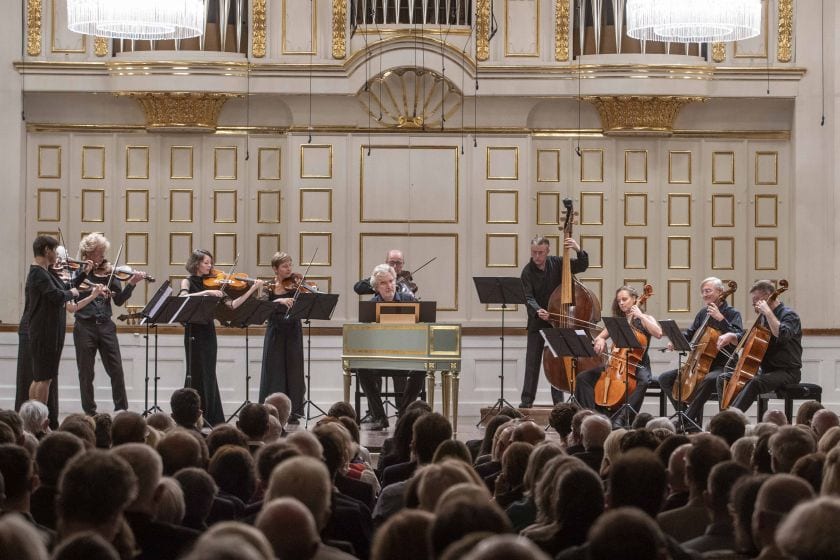
András Schiff moves, by contrast, entirely within the 18th century when on 13 August in the Mozarteum he confronts his two central composers Bach and Mozart. Bach appears the following day also with Isabelle Faust and Kristian Bezuidenhout – the great hall of the Mozarteum thus becomes on two consecutive evenings the scene of a confrontation of fundamental interpretive questions: while Schiff is happy to play Bach also on modern instruments, Bezuidenhout – not least in collaboration with Isabelle Faust – has set new standards for the “original sound” era and performs with his partner, who plays her violin with gut strings, on the harpsichord.
Retrograde Time Travel. Quite different a week later (21 August): the duo Martha Argerich and Renaud Capuçon, who will undertake a retrograde time travel by moving from Debussy’s late Violin Sonata through Schumann’s Second (D minor, op. 121) to Beethoven’s last Sonata (G major, op. 96), thereby tracing a history of sonata form from the breakthrough into modernity back to its roots. Kristian Bezuidenhout begins his Salzburg séjour on 14 August with a solo concert with Isabelle Faust, continues on 22/23 August within a Mozart matinée under Giovanni Antonini with Mozart’s last piano concerto, B-flat major (KV 595), and returns on 26 August to Haus für Mozart as the partner of the significant cellist Sol Gabetta. The pianist will perform at this year’s Festival on instruments of widely varying construction, in order to dedicate himself to the broad repertoire from the Baroque through to Fantasy pieces, Sonatas and »Songs Without Words« from the pen of Mendelssohn, Schumann and Brahms. Establishing such cross-connections is one of the finest tasks of festivals, which also make room for innovative forms of narrative that turn the concert hall into a field of experimentation. An artist like Patricia Kopatchinskaja has for a long time not been content with working through established concert rituals. For the Ouverture spirituelle of this year’s Festival she has programmed an evening called »Les Adieux« – which not only bears the name of one of Beethoven’s most famous piano sonatas, but takes as its starting point his Sixth Symphony: the first four movements of this so-called “Sinfonia pastorale” lead us back to the “Awakening of cheerful feelings upon arrival in the country”, as the composer headed the first movement, to an idyllic “Scene by the Brook” and a “Merry gathering of country folk” interrupted by a sudden thunderstorm.
Now comes leave-taking, Kopatchinskaja style – not Beethoven’s hymn-like invocations of merging into divine nature, but a questioning from a contemporary perspective: “Nature is no longer as idyllic and intact as it was in Beethoven’s day. What we have done to nature is irreversible,” says the violinist, who in this case has mutated into a conceptual artist. Following the Beethoven fragment come Robert Schumann’s »Geistervariationen« and the middle movement from his late, barely performed Violin Concerto, then the finale from Dmitri Shostakovich’s First Violin Concerto and finally excerpts from Luigi Nono’s »Ricorda cosa ti hanno fatto in Auschwitz« – which should explain that what is being shown here is not only what humanity has done to nature. At the end stands an improvisation by Abraham Cupeiro on a prehistoric instrument, and the thoughts of the audience may perhaps drift back to imagine what it might once have been like …

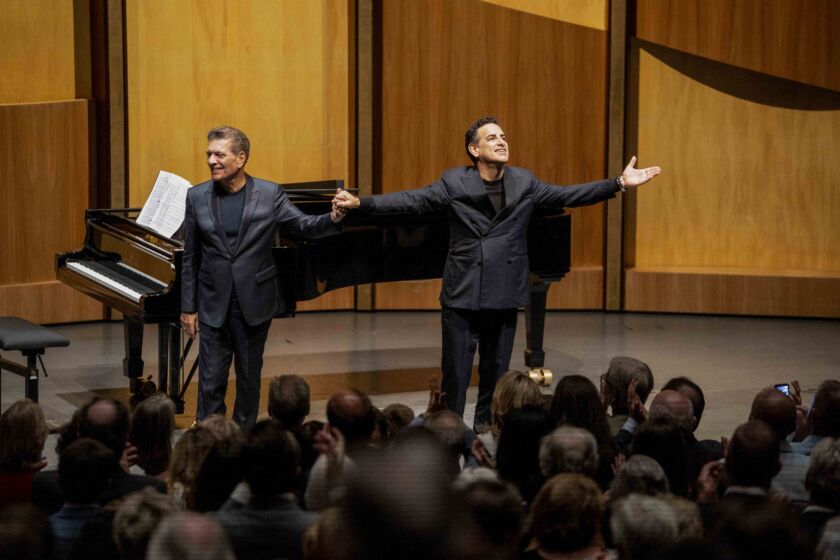
On the Wings of Song. Very varied and rich in connection are also the song recitals at the Salzburg Festival 2026, which not infrequently offer vocal chamber music and opera concerts of a particular kind, as Michael Spyres with the ensemble Il Pomo d’Oro demonstrates on 27 July at the Haus für Mozart, letting one hear arias and scenes from works by Handel, Vivaldi, Rameau, Porpora and other masters; or Juan Diego Flórez, who on 30 August with Vincenzo Scalera lets the following generations of Italian and French masters from Rossini, Bellini and Boieldieu to Verdi and Massenet pass in review and perhaps reaches for the guitar at the end to accompany a few encores himself …
Lea Desandre with the Jupiter Ensemble under the direction of lutenist Thomas Dunford concentrates entirely on Vivaldi on 31 July in the Felsenreitschule: instrumental works by the composer provide relaxed intermezzi between music-theatrical excitements of all kinds, such as the Vivaldi who was also a virtuosic opera composer knew how to kindle.
Viennese Modernism and Zarzuelas. Kate Lindsey in turn, with pianist and arranger Baptiste Trotignon at the Haus für Mozart (16 August), illuminates her early modernism and its astonishing manifestations in the most varied musical theatre genres: once again the acoustic journey sets out from plain Lied singing, from Erich Wolfgang Korngold’s »Simple Songs« or from songs by his teacher Alexander Zemlinsky, whose “Selige Stunde” (Blessed Hour) was again the favourite song of Alma Mahler when she was still called Alma Schindler and was turning the heads of Zemlinsky (and not only him). Joining these three Viennese masters is Kurt Weill, who placed his highly elaborate artistry in the service of musical modernism also for the American musical and contributed not a little to raising that genre to an unaccustomed level.
Also in Konstantin Krimmel’s Lieder programme based on Schumann and Brahms (Mozarteum 7 August) there appears Eusebius Mandyczewski, whose name one would probably have entirely forgotten were it not for the services to Viennese musical life he earned not least as archivist of the Gesellschaft der Musikfreunde. And finally Lisette Oropesa’s evening with Rubén Fernández Aguirre (Mozarteum, 18 August) also offers, alongside the expected listening pleasure, a pedagogical aspect: when does one hear a concentrated sequence of Spanish vocal art, from de Falla’s »Canciones populares españolas« through Lecuona’s »Granada« to numbers from the Spanish special form of operetta, the Zarzuela?
Text: Wilhelm Sinkovicz
First published on 16.05.2026 in Die Presse Kultur Spezial: Salzburger Festspiele