
“Bon Voyage” with Gianluca Capuano
Only recently, Gianluca Capuano received the OPER! Award for “Best Conductor of the Year” for his musical leadership of last year’s Salzburg Whitsun Festival production. Gioachino Rossini’s opera Il viaggio a Reims will be performed for the first time in Salzburg at Whitsun, and Gianluca Capuano dedicates himself to this score for the first time.In conversation, he discusses his understanding of Rossini and his fruitful collaboration with Cecilia Bartoli.
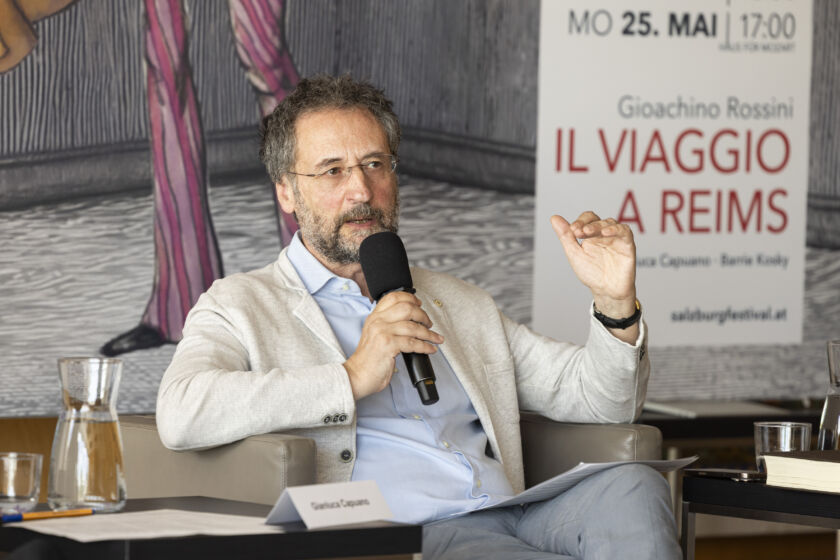
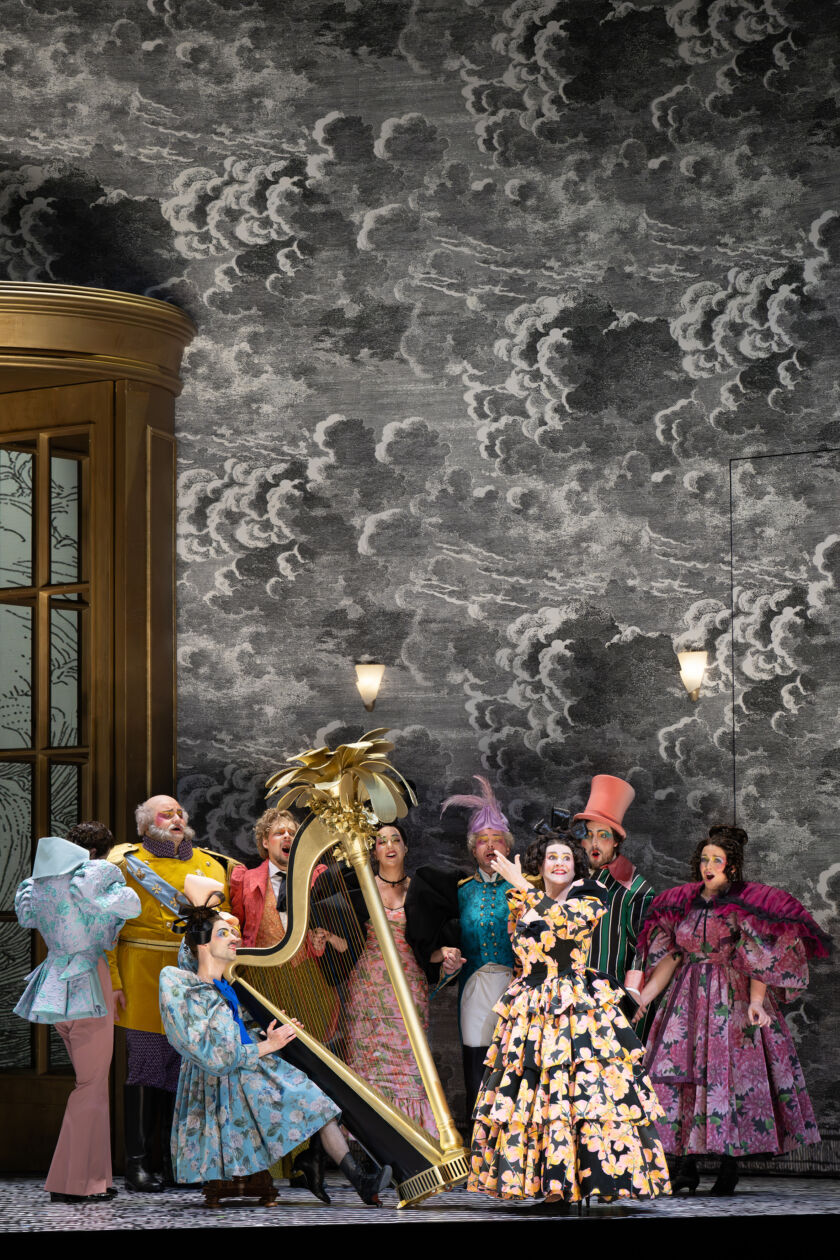
How would you describe Il viaggio a Reims as a work?
Gianluca Capuano: After the great success of the Vivaldi pasticcio Hotel Metamorphosis, Barrie Kosky and I are now dedicating ourselves to Il viaggio a Reims, a completely independent work. This is not a “pastiche” or “pasticcio” in the narrow sense, even though it is rich in self-quotation. Its nine scenes are modular, meaning they are potentially interchangeable. A principle Rossini also applied to his subsequent French opera Le Comte Ory (1828), incorporating significant amounts of material from Il viaggio.
Il viaggio a Reims was the first opera Rossini composed for Paris, and on this occasion he was testing a new compositional style, which was meant to adapt to the local audience’s taste as best he could. At the same time, some of the numbers are his most experimental, perhaps the culmination of Rossini’s entire output, especially the sextet and the “gran pezzo concertato” – an ensemble for 14 voices.
The modern rediscovery of Il Viaggio, which had long been believed lost, resembles an espionage story: thanks to vague tip-offs and sensational manuscript discoveries in Paris and Rome, the Rossini expert Philip Gossett and later Janet Johnson – the editor of the critical Rossini edition – were able to reconstruct the work in the late 1970s by comparing the extant sources. After the world premiere in June 1825, a meagre three further performances and revised versions for Paris and Vienna, all traces of Il viaggio a Reims were lost. Not until 1984 did Claudio Abbado and Luca Ronconi present this purportedly missing jewel to the world in Pesaro. This decisively altered widely-held notions about Rossini’s development as a composer.
You are considered an expert on interpretations reconstructing the original sound of works. How would you describe the current state of historically informed performance practice – also with regard to Rossini’s music?
Comprehensive research on the sources and performance practice of Rossini’s music has been done by the Fondazione Rossini in Pesaro, which has published the critical editions of the works – an essential starting point for all those performing Rossini today.
What role has Rossini’s music played for your own development as an artist?
After I had first worked with Cecilia Bartoli as a conductor on Norma in Edinburgh in 2016, we undertook a lengthy tour together with La Cenerentola. For me, it was an extraordinary debut to conduct one of Rossini’s most famous operas with true icons of this repertoire such as Cecilia Bartoli, Alessandro Corbelli and Carlos Chausson. Ever since, Rossini has been a constant presence in my repertoire, all the way to my debut at the Teatro alla Scala di Milano, where I also conducted La Cenerentola in September 2025. Since I had studied mainly the early music repertoire, before Rossini, and did not arrive at his oeuvre – like many other conductors – via Verdi, I have developed a clear idea of how I wish to interpret his music. Some critics have credited me with bringing some fresh air to the understanding of this musical world. What I am still looking for is a chance to conduct “Rossini serio”, his tragic operas, more frequently, but I am convinced that the coming years will bring such opportunities.
What makes your artistic collaboration with Cecilia Bartoli so special to you?
My encounter with Cecilia has certainly changed the course of my career. The extraordinary element of our collaboration, to me, is not least the opportunity to exchange thoughts on interpretation with one of the pre-eminent performers of our time. We certainly share a similar way of feeling about musical theatre, but also a strong awareness of philology and intense curiosity about less-frequently performed repertoire.
Furthermore, the involvement of the orchestra Cecilia Bartoli founded in 2016 especially for our projects, Les Musiciens du Prince – Monaco, ensures that all those involved in a performance are oriented towards the same goal. And that is something the audience has noticed increasingly over recent years. The greatest compliment I can receive after a performance of a frequently-performed work is that people had never heard it like this before. I am certain our Salzburg interpretation of Il viaggio a Reims will cause a splash