
STAGING REALITIES – THE LIVING ARCHIVE
Production images
Iz Paehr · Feeling Virtual: An Archive of Touch
The installation Feeling Virtual: An Archive of Touch by the Berlin-based artist Iz Paehr invites visitors to touch archival materials. ‘How does it feel to hold a piece of operatic history in your hands?’ asks Iz Paehr, whose project focuses on tactile records. 3D models of historical objects from the Festival’s past – such as costumes from the 1960 production of Der Rosenkavalier or props and costumes from the 1997 Zauberflöte – are made accessible as virtual experiences that can be felt through touch, vibration and detailed tactile descriptions. The artist understands disability as a creative force, one that reshapes our relationship to archives and inspires new forms of artistic expression. Visitors are invited to immerse themselves in a multi-sensory experience that connects them with costumes and props from the Salzburg Festival’s Archive.
‘Building on the embodied knowledge of disabled people, this project allows the Archive to be experienced in tactile form. Through innovative VR experiences that foreground the sense of touch, archival materials become something to be felt as much as seen. Haptic sculptures guide visitors through virtual points of contact, inviting people of all bodies and minds to engage with them.’ (Iz Paehr)
Cooperation between the Salzburg Festival, Ars Electronica Linz and the Institute for Open Arts at the Mozarteum Salzburg as part of S+T+ARTS Ec(h)o, funded by the European Union
Merve Sahin · Merging Visions
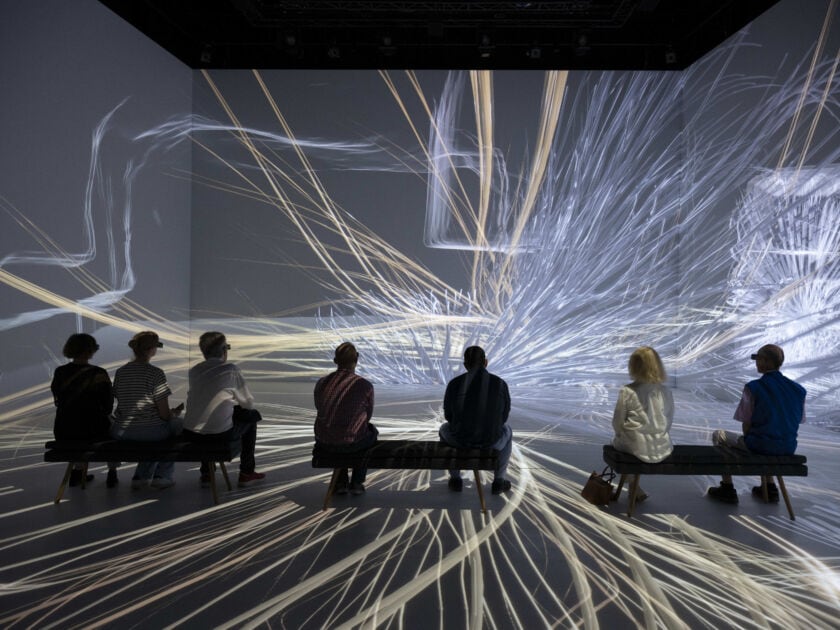
Merging Visions is a two-part immersive installation by Vienna-based artist and architect Merve Sahin. It offers a fresh look at the Salzburg Festival’s performance venues and their impact on the natural landscape, presenting the built environment as a space of permanent transformation, interwoven with nature and the cyclical patterns of history that shape it. The project uncovers the historical, cultural and ecological layers that make up the Festival complex. The ongoing evolution of the Festival’s performance infrastructure is made tangible in a mixed-reality experience, which presents a continuous dialogue between nature and culture and reveals the venues as a living interface between the city, the Mönchsberg and the human imagination.
In a VR experience at the X-Reality Lab, historical drawings, digital models and the sounds of the Festival are brought to life, creating an immersive environment where architecture, ecology and cultural memory converge in Salzburg. The physical installation, Garden of Objects, invites visitors to engage more closely with material specimens from the Festival grounds, prompting reflection on our relationship with nature, the enduring presence of natural landscapes and the fleeting character of artistic performance.
Cooperation between the Salzburg Festival and Ars Electronica Linz, the Media Solution Centre Baden-Württemberg and the High Performance Computing Centre Stuttgart, as well as the Institute for Open Arts at the Mozarteum Salzburg as part of S+T+ARTS Ec(h)o, funded by the European Union
Mats Staub · Festspiel-Erinnerungsbüro
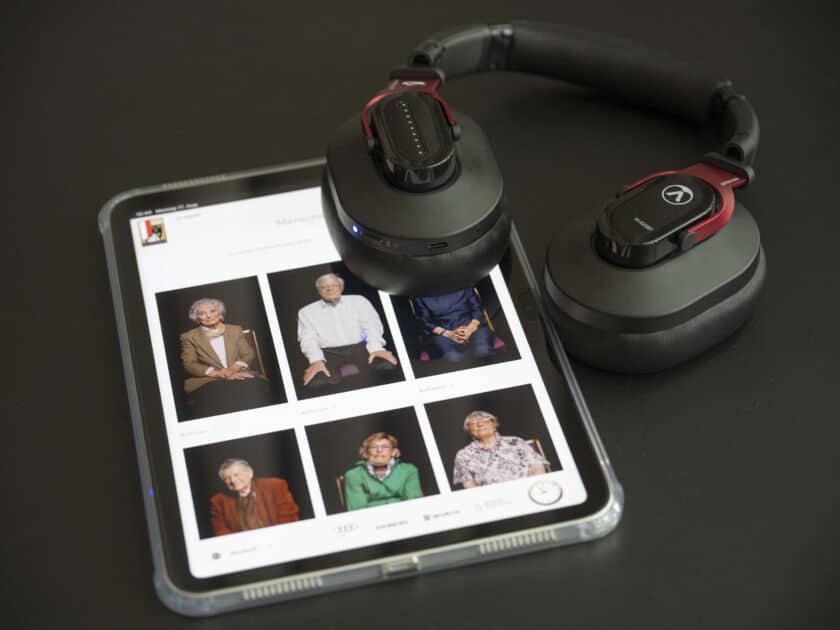
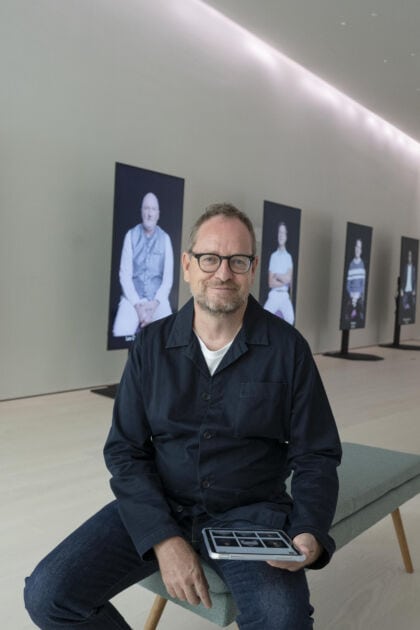
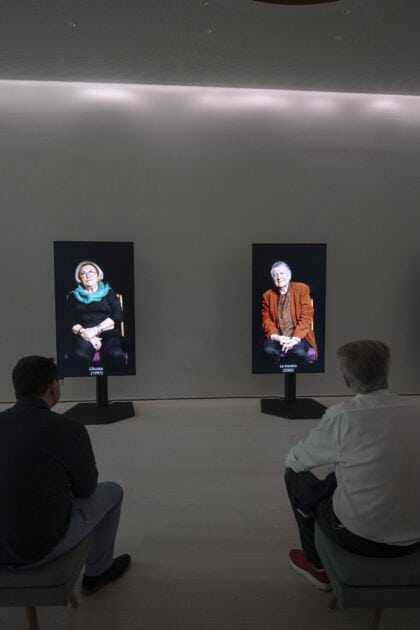
Mats Staub – ‘a traveller and curator in the realm of memory’ – has spent the past 20 years creating arts projects that weave together theatre and exhibition, research and literature, while always placing people and their life stories at the centre. For Salzburg, he has conceived a project that turns the spotlight on the memories of Festival goers: the audience itself becomes visible, and the Festival’s milestones and turning points echo through a multitude of voices. Through the Festival Memory Office, an archive of personal Festival memories takes shape – made visible through gestures and expressions captured in a video installation, and audible through the participants’ spoken recollections.
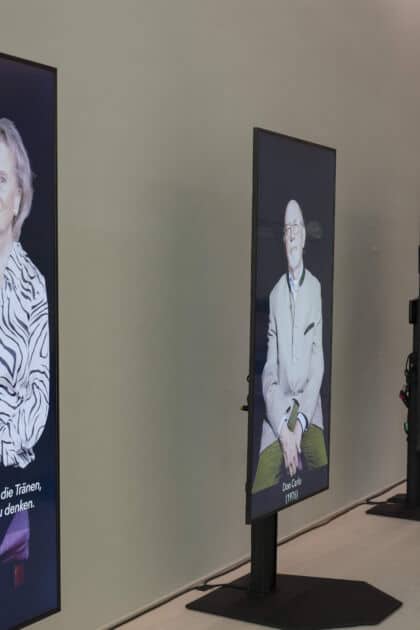
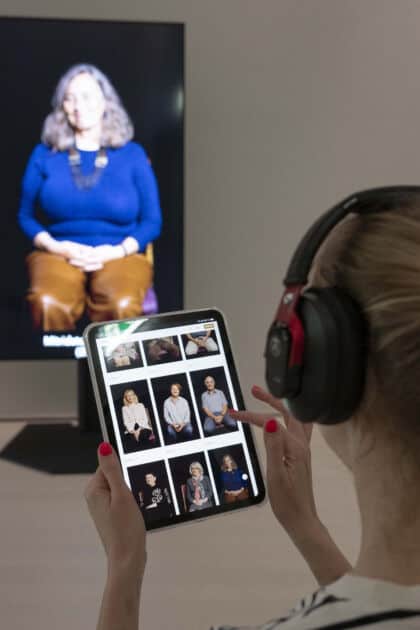
Five monitors show life-size video portraits of 45 people from different generations, each silently recalling the performances that left a lasting impression on them. With each monitor representing a different era, together they create a panorama of the Festival’s history – from Jedermann in 1949 and Saint François d’Assise in 1992 through to the Nachtmusik series in 2025. An audio device enables visitors to listen to the speakers’ memories while they reflect on their own. This quietly theatrical and moving installation opens up a space for people to identify or reconnect with emotions – and to experience the Festival in a special, perhaps more personal, way.
Salzburg Festival’s own production
FAUST 2023
In 2023 – marking 150 years since the birth of the Salzburg Festival’s co-founder Max Reinhardt – the archive project FAUST 2023 was created in collaboration with Ars Electronica and the Ars Electronica Futurelab. Drawing on the Festival’s archival holdings, the project turned these materials into an immersive virtual reality experience. As the Salzburg Festival prepares for a new staging of Faust in 2026, the revival of this VR experience – centred on a virtual reconstruction of Clemens Holzmeister’s legendary ‘Faust town’ in the Felsenreitschule (created for Reinhardt‘s 1933 Faust production) – builds a bridge between the Festival’s current season and the ongoing Living Archive initiative.
The digital reconstruction of the Faust town was based on original plans, photographs and other records from the Salzburg Festival Archive. A large number of photos were corrected for perspective and, in some cases, enhanced with AI tools. Original archival photos were integrated into the 3D models as surface imagery, with the aim of creating an accurate reproduction of the historical stage design within the technical scope of VR headsets.
This year, FAUST VR is presented in UMAK’s X-Reality Lab. The experience begins with an introduction to the historical, political, social and theatrical contexts of Reinhardt’s Faust production, and integrates a wide variety of media elements: narration, photographs, film clips and audio recordings.
Co-production of the Salzburg Festival with Ars Electronica Linz and the Institute for Open Arts at the Mozarteum Salzburg
Symposium
Building on projects connected to the Festival Archive and the fact that live performances cannot be fully archived, but only documented, this full-day symposium focuses on how performed works can be preserved. It will explore questions of how living archives can restore the auratic experience, as well as issues of participation and access: who gets to enter the archive, and who holds authority over it? How can archives serve as spaces of memory and knowledge for everyone? The experts and artists at the symposium will discuss living archive theories, approaches to making archives accessible and the use of VR and AI to preserve live performance.
In cooperation with the Friends of the Salzburg Festival Association, the Robert Jungk Library for Future Issues, Ars Electronica Linz and the Institute for Open Arts at the Mozarteum University