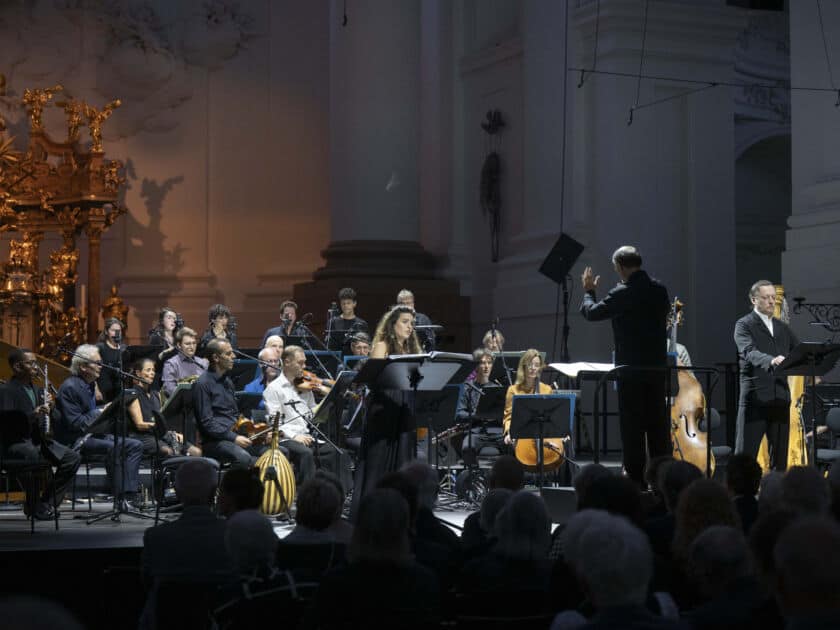
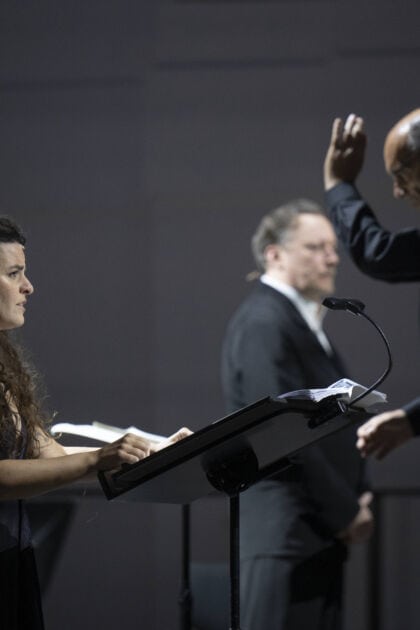
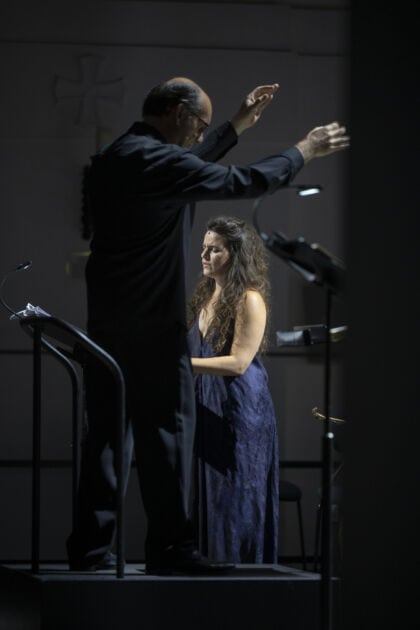
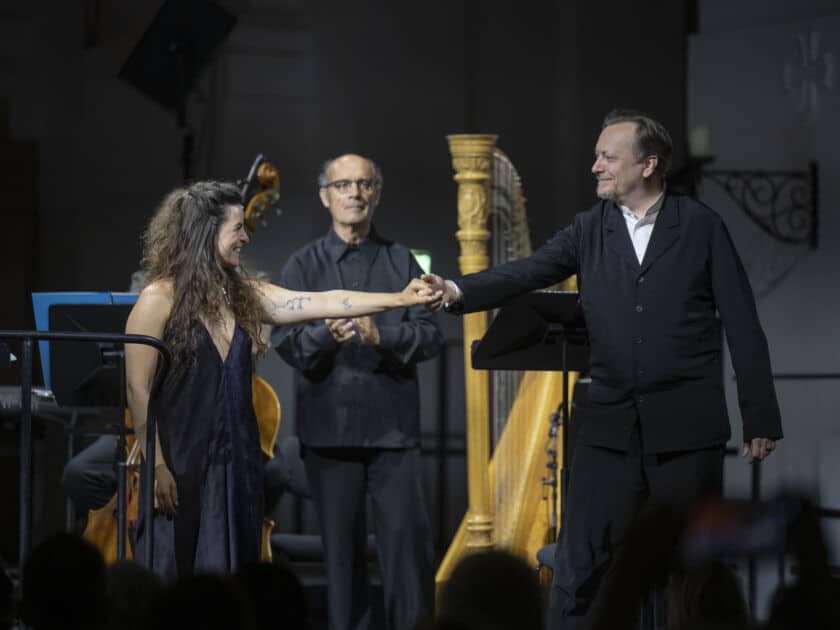
Simply She and He – ‘Lei’ and ‘Lui’ – is what the composer Pascal Dusapin called the two solo roles in his opera Passion, and yet the characters of Orpheus and Eurydice echo in them like a distant memory. Numerous issues occupied Dusapin when he was planning this, his sixth music theatre work – such as whether Orpheus consciously looks back at Eurydice on his return from the Underworld because he has realized how much her disappearance and the pain of his loss have in fact inspired him as an artist. These questions led him to make significant changes to the myth. In Dusapin, the woman is not sacrificed like Eurydice: here, she refuses to follow the man, and neither does he return to the land of the living.
First performed in 2008, this opera develops as a dialogue of a couple moving between rapprochement and estrangement. It is structured in ten interlocking sections, to each of which Dusapin gave the same title as to the work as a whole: Passion. He had long been considering a project whose central topic would be the musical expression of ‘passions of the soul’. When the Festival d’Aix-en-Provence commissioned Dusapin in 2005 to compose a stage work that engaged with the three surviving operas by Claudio Monteverdi, he immediately thought of the immense importance that this operatic pioneer had assigned to expressing emotions and affects. Accordingly, he decided to combine this commission with his ‘passions’ project.
Thus, Lei and Lui find themselves in an uninterrupted flow of shifting mental states. ‘Their passions’, says the composer, ‘overlap, collide and divide into a multitude of different paths marked by fear, joy, pain, terror, desire, delight, sorrow, love and anger’. Dusapin’s score makes subtle references to Monteverdi and the Baroque, yet he creates a sound world all of his own. This is music that radiates a calm tension, hypnotic power and austere beauty.
Christian Arseni
Translation: Chris Walton