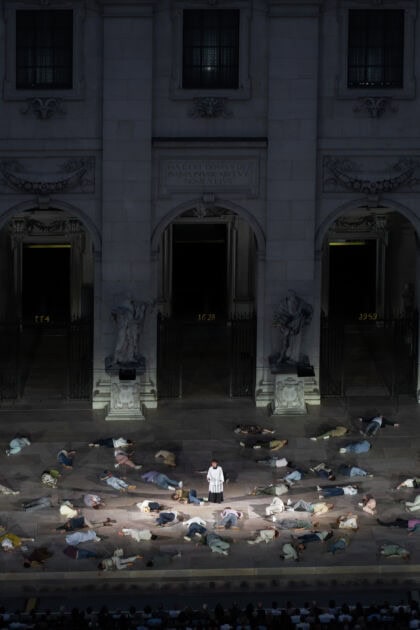
Life is good. And Everyman’s life is very good indeed. His businesses are remarkably successful. His wealth is spectacular. He owns the finest house in town, has an army of servants to do his bidding, and an art collection that would be the envy of any museum. Never short of company, he is a lavish host, whose parties are legendary. And he is in love. He and Buhlschaft even seem ready to take their relationship to a new level, to turn it into something more permanent. But at precisely this point, when he is in his absolute prime, at the height of the social event of the year – Death arrives. Death comes for Everyman. No one else – not yet. Just him. Alone.
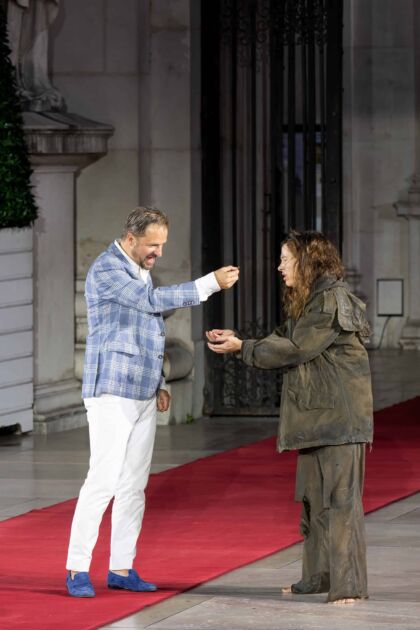
For Everyman, this abrupt collision with his own mortality is hard to believe, let alone understand or accept. In this instance, the exceptional wealth he has accumulated is of no help to him. And the knowledge that Death will also come for others – and indeed must come for everyone sooner or later – is no comfort. His initial reaction is to treat Death’s arrival as an obstacle to be overcome like so many others in his professional and personal life: a problem that can be resolved through negotiation, charm, connections, refusing to take no for an answer or, if necessary, substantial sums of cold, hard cash. Only when these efforts fail, and Everyman has been abandoned by all those who were more than happy to eat his food and drink his champagne just a few moments earlier, does he begin to process the fact that his life is over.
It is a situation for which Everyman is entirely unprepared. He is forced, perhaps for the very first time, to account for his life in more than purely financial terms, and his mind is filled with multiple, at times conflicting, emotions. Behind these lurk questions, the sort of questions that countless others have already asked when their time has come: How could I have avoided this? What good did I achieve? Why was I so obsessed with the here and now? How did I ignore so many important things? Why didn’t I behave differently? What does it all mean? And: Is there really nothing I can do to make amends?
Hugo von Hofmannsthal’s play draws on medieval morality plays that were already many centuries old when he read them. While his version remains anchored within the Christian faith that he himself practised, Hofmannsthal noted in an essay written in 1912 shortly after he completed Jedermann that the material was timeless and ‘not even indissolubly connected to Christian dogma’. Despite the play’s explicit focus on the death of a rich man, his aim was for its meaning to apply universally.
Hofmannsthal’s Jedermann has been a core element of the Salzburg Festival programme since its inception in 1920. Beyond its ever-topical theme, another key reason for its enduring resonance is the highly distinctive language, which its author took several years to forge. The play’s verse text has a deliberate patina of age, but a vibrant, driving energy is alive within it. Its irregular rhythms and rhyme schemes lend the dialogue a cohesive power while never allowing it to become predictable. This is language to savour, and which always retains an ability to surprise.
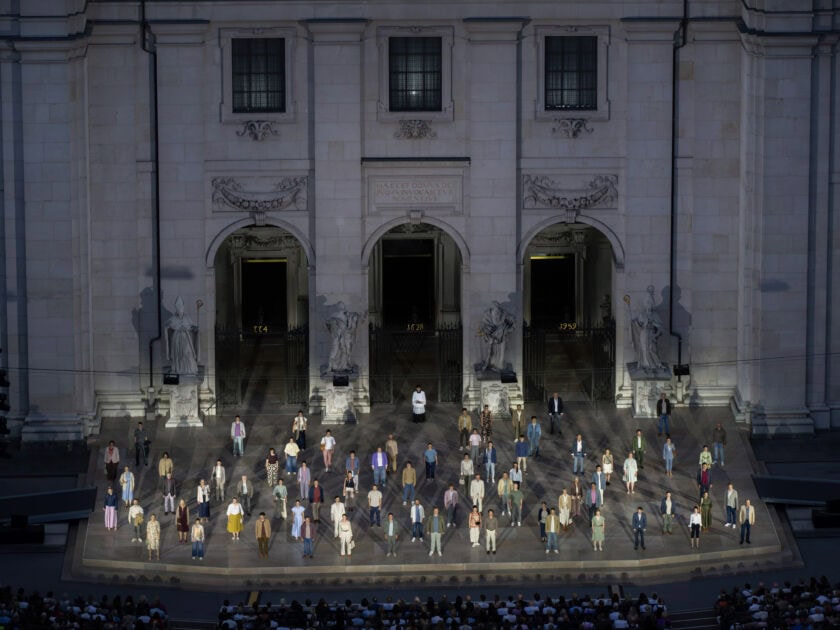
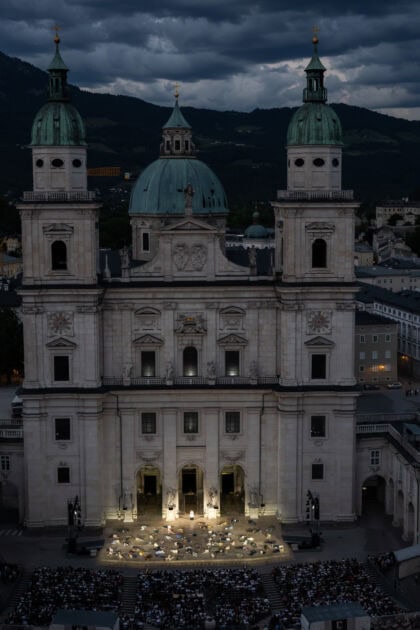
Attending a performance in the Cathedral Square (or the Grosses Festspielhaus in the event of bad weather) means rather more than simply watching a play: it is to take part in what is now a ritual that has extended for over a century, and to share elements of an experience in which we engage with the same ideas and emotions that have fascinated a whole series of earlier generations – because, whether we like it or not, ultimately they will affect us all.
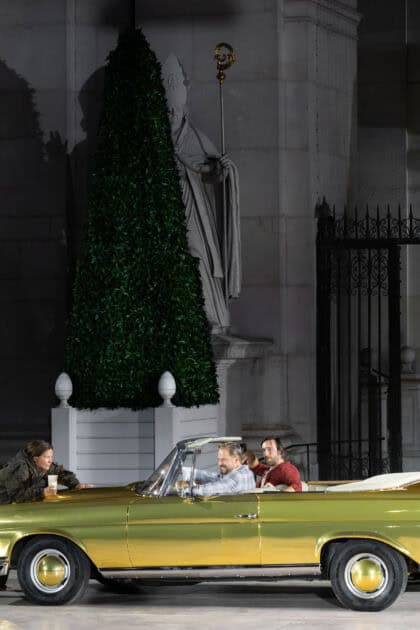
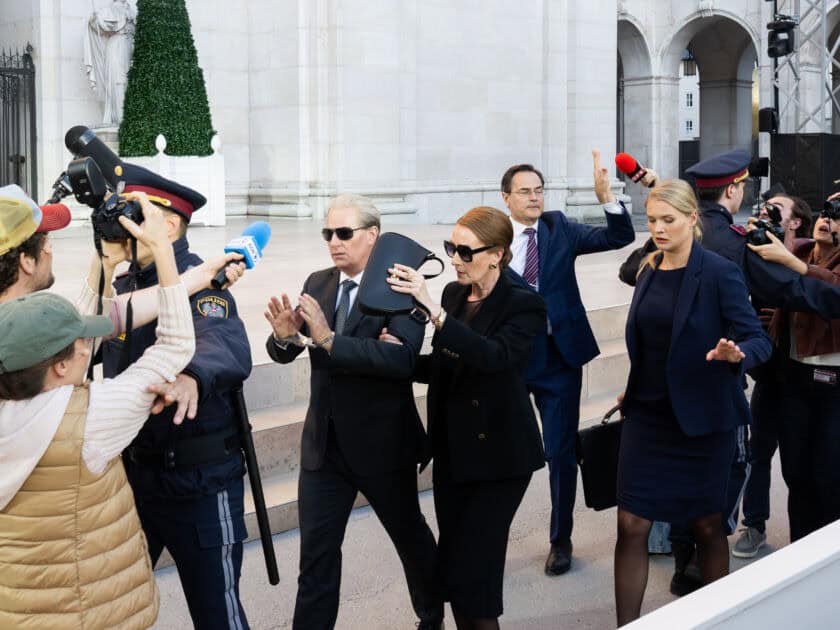
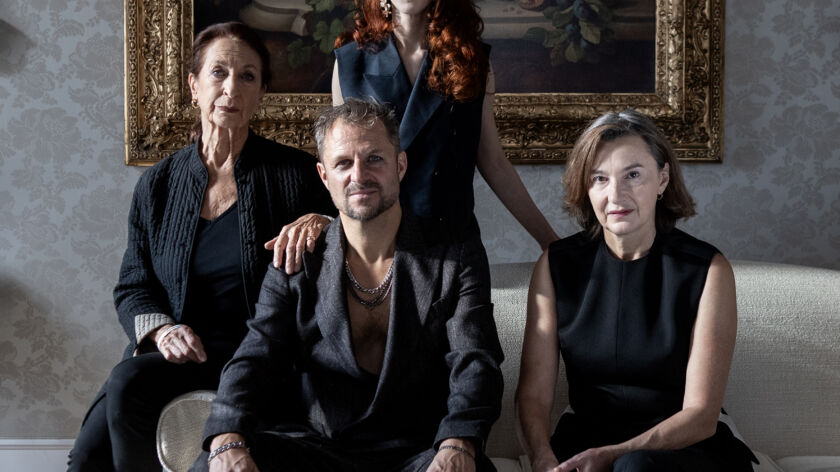
Robert Carsen’s production responds to this tradition by creating a vivid, contemporary world whose opulent detail and panoramic scale accentuate Hofmannsthal’s critique of materialistic values and call for more profound spiritual reflection. This highly acclaimed interpretation now returns for its third year with Philipp Hochmair in the title role.
David Tushingham