Il viaggio a Reims
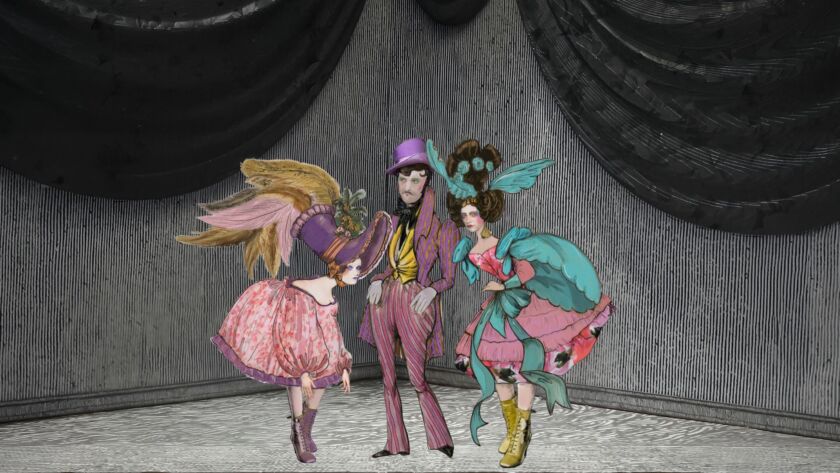
“Bon voyage!” is artistic director Cecilia Bartoli’s motto for Whitsun – she has dedicated her entire programme to the theme of travel. With the opera production, which will be revived during the summer, she once again pays homage to one of her favourite composers: Rossini’s Il viaggio a Reims draws comedic capital from a failed journey. In conversation, the director Barrie Kosky describes his approach to this extravagant comedy about travellers marooned at a hotel.
Il viaggio a Reims is unusual in several regards. What makes it so special?
Barrie Kosky: Il viaggio a Reims is interesting for a few reasons. Firstly, it’s the last opera Rossini wrote in Italian. Everything he wrote after this was in French, and with the exception of Le Comte Ory, they were not comedies. So Il viaggio was the last of an incredible body of work that he’d built up in the Italian comic repertoire. Secondly, the piece has a very interesting conception because it was written in 1825 to celebrate the coronation of Charles X in Paris, and it was not intended to be performed after the first series of performances. Then Il viaggio was forgotten, and much of its music was soon considered lost. And it was only in the late 20th century that musicologists started to reconstruct the work, thanks to rediscovered sources. Claudio Abbado conducted the first modern production of the piece in Pesaro in 1984, which was a sensation. The music in Il viaggio is some of the best Rossini ever wrote.
The fact that it’s a “celebratory opera” is reflected not least in the number of roles …
Yes, there are no less than ten main roles plus eight smaller roles, and the chorus. That is not the only challenge for the director: there are amazing arias and – the real hallmark of Rossini’s comedies – extraordinary ensembles, but hardly a narrative. The plot is very simple. A group of people are on their way to the coronation of Charles X, and their carriage breaks down. They end up in a spa hotel in the middle of nowhere. And during their time at the spa hotel, there are a number of intrigues, a few romantic liaisons, a lot of comic activity, but nothing much happens. As the starting point for comedy, that’s perfect: a group of random people come together, they’re stuck in a confined space, crazy shit happens – we know this from literature, theatre, film.
What the sparse narrative of the opera gives a director like me is a gift, because I can invent another story. That was my point of departure for the production. I always felt that there had to be something Feydeau-esque about it.
George Feydeau, who worked later than Rossini, around the turn of the century, is one of my favourite playwrights. He was one of the instigators of slapstick in film. Feydeau invented this special form of farce, with incredibly fast entrances and exits, with slapstick in a risqué combination with sexuality – secret rendezvous in hotel rooms, lovers being discovered, compromising situations. Some of this world that Feydeau developed, that you then see in the Marx Brothers films, will also be found in my production.
What I hope to achieve is a sort of theatrical inebriation, a kind of delirium. To me, Rossini’s Italian comic music is the music of delirium. Of course it’s got lovely melodious sections, but the overall feeling is a world almost spinning out of control – as it does in Offenbach.
The guests we meet at the spa come from very different countries, and the opera openly plays with national clichés. How do you deal with this?
This portrayal, almost a caricature, is one of the reasons Il viaggio a Reims is so fascinating. You have a fashion-crazy French woman and a flirting Frenchman, an artist and an antiques-loving scholar from Italy, a German, a Pole, a Spaniard and an Englishman. The fact that they are all singing in Italian, only occasionally using words from their native languages, gives the thing a surreal note. I could have done Il viaggio as a sort of farce about the EU now, but it won’t sustain for three hours without robbing it of its lightness – Il viaggio is like a soufflé.
Of course, Rossini was playing with stereotypes and cliché, and you have to honour that, without going too far. There’s a very famous scene at the end when they all sing their versions of nationalistic songs. But the joke is in the music. If you overlay that too much with other jokes, then the joke dies. And I think that you have to walk a very fine line between outrageous slapstick and keeping it human, because the slapstick is only funny if it’s human slapstick.
Interview: Christian Arseni
First published in the Festival insert of Salzburger Nachrichten